

POSTED BY:
COMMENTS:
0
POST DATE:
Welcome to the crossroads every serious Nigerian entrepreneur reaches. This is where you face the two-headed giant: Legitimacy (CAC Registration) and Capital (SME Loans). Many people treat them as two separate fights. They believe they can chase one without the other. Let me tell you straight, as someone who has seen businesses rise and fall for over a decade: that thinking is the fastest way to remain a small-timer.
In this guide, we are not just talking about how to register your business or how to get a loan. We are talking about how registering your business is the master key that unlocks the door to serious funding. Forget the shortcuts. Let's build a proper foundation.
Why Formalizing Your Business with CAC Registration is Crucial
Let's be honest. Running a business from your personal account feels easy. No stress, no taxman wahala. But you are leaving so much money and opportunity on the table. Registering your business with the Corporate Affairs Commission (CAC) is not about paying fees; it's about changing your level.- Trust is Your Number One Currency: When a customer sees a registered business name, they feel safer. They know you are not a ghost who can disappear with their money tomorrow. It shows you are serious.
- Open a Corporate Bank Account: This is a game-changer. It separates your personal funds from your business funds. No more using your child's school fees to buy market. It professionalizes your finances and is the first thing any lender will ask to see.
- Access to Opportunities: Want to apply for a government grant? Want to be a supplier for a big company? Want to bid on a contract? The first document they will ask for is your CAC certificate. Without it, you are invisible.
Decoding CAC Registration: Business Name vs. Limited Company
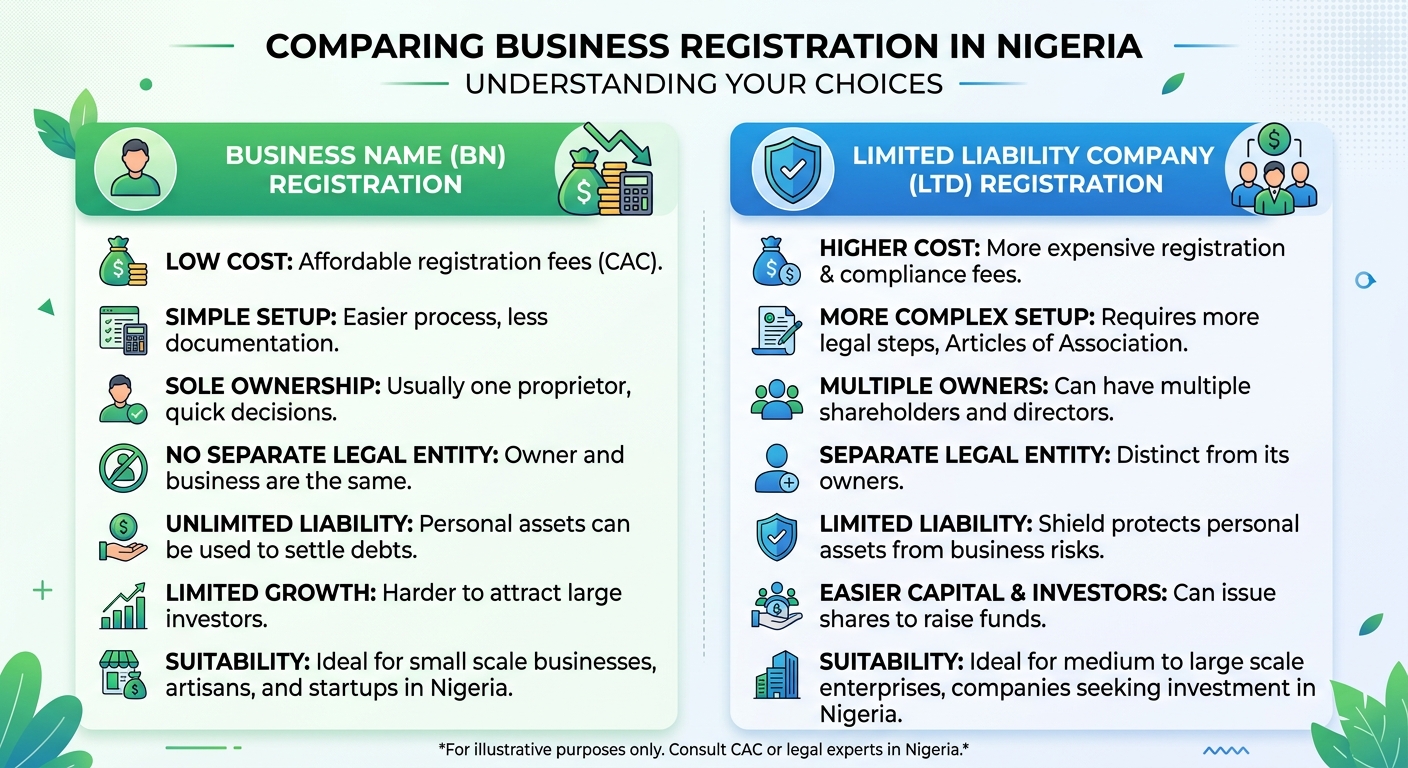
When you hear CAC, don't get confused. There are different strokes for different folks. For a small business owner, your main choices are these two:- Business Name (Sole Proprietorship/Partnership): This is the simplest and cheapest option. You and your business are legally the same entity. If the business incurs debt, your personal assets can be used to pay it. It’s perfect for freelancers, small shop owners, and consultants just starting out. It's a fantastic first step.
- Best for: Side hustles going legit, personal brands, small-scale traders.
- Advantage: Cheaper, faster registration, less complex compliance.
- Private Limited Company (LTD): This is the next level. The company is a separate legal entity from you, the owner. If the company owes money, they can only touch the company's assets, not your personal house or car (this is called "limited liability"). It's more expensive and complex to set up and maintain, but it signals to investors and banks that you are playing in the big leagues.
- Best for: Businesses aiming for growth, seeking investors, or dealing with high-value contracts.
- Advantage: Protects your personal assets, looks more professional, easier to attract investors.
A Step-by-Step Guide to Online CAC Registration in Nigeria
In the old days, you needed an agent or lawyer who would charge you a fortune. Today, you can do most of it yourself from your phone or laptop if you have the patience.- Create an Account: Go to the official CAC Registration Portal and create an account.
- Name Reservation: This is the first test. Search for your proposed business name to see if it's available. If it is, you pay a small fee to reserve it. Be creative; common names are likely taken.
- Fill the Registration Form: Once your name is approved, you fill out the detailed form. This includes your business address, the nature of your business, and your personal details (you'll need a valid government-issued ID like your NIN slip or a driver's license).
- Make Payment: Pay the official registration fees online. The cost will depend on whether you chose a Business Name or a Limited Company.
- Upload Documents: Scan and upload your signature and a passport photograph.
- Download and Wait: After submission, you will receive your certificate and other documents electronically once approved.
The Golden Ticket: How CAC Registration Unlocks SME Loans
Now we get to the heart of the matter. You have your shiny CAC certificate. So what? Why does a bank manager care? Think of it from their perspective. A bank is not a charity; they are in the business of managing risk. When you walk in as an individual asking for money for your "business," they see only you. If you run away, who do they hold responsible? But when you walk in with a CAC certificate and a corporate bank account, they see a structured entity.- It proves you exist: The certificate is government-backed proof that your business is real and not a phantom.
- It enables due diligence: They can search for your business on the CAC portal. They can see your registered address and directors. You are traceable.
- It allows for formal lending: A loan can be made out to "Segun Okonjo Enterprises" instead of just "Segun Okonjo." This creates a clear legal and financial trail.
- It shows seriousness: It tells them you have invested time and money into formalizing your business. You are less likely to disappear overnight.
Navigating the SME Loan Landscape in Nigeria
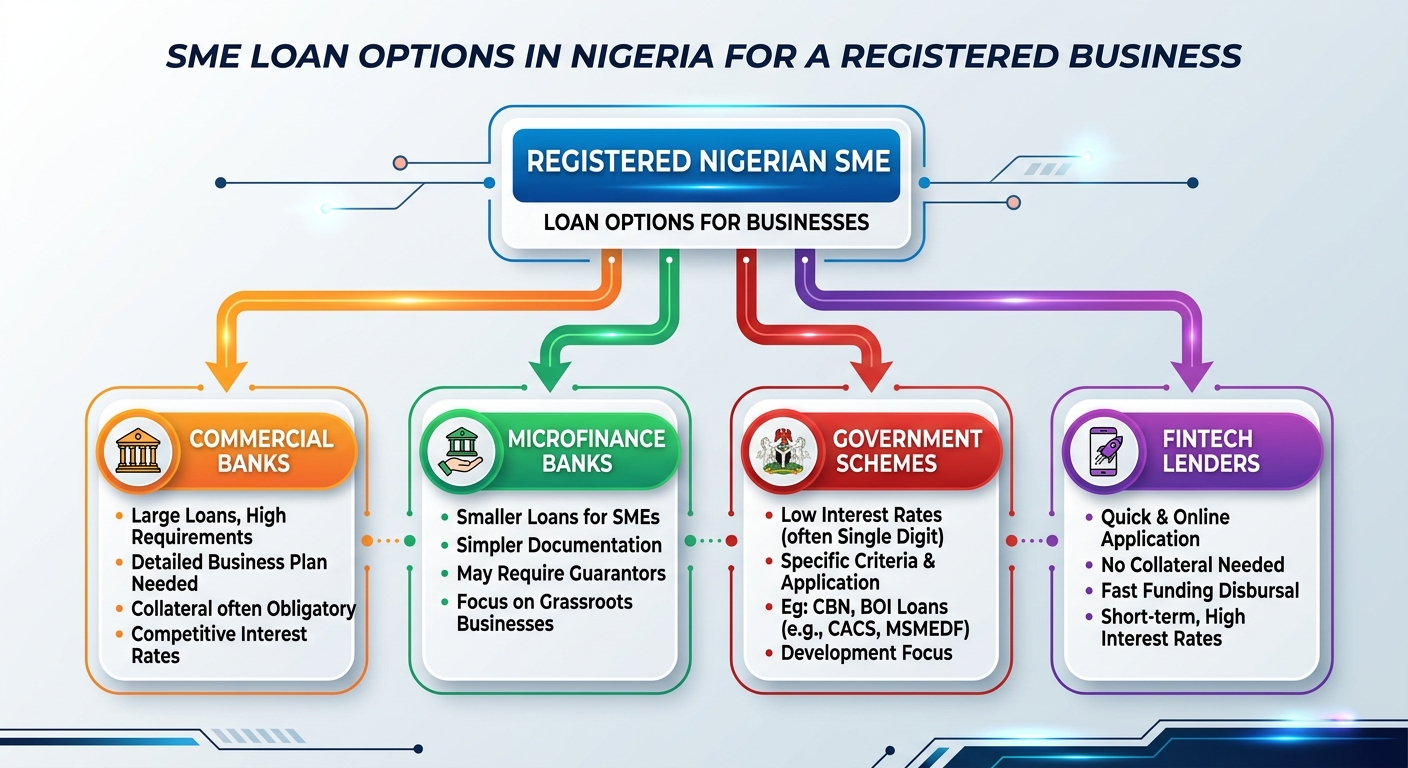
Once you are registered, a new world of funding opens up. Here is a quick tour of your options:- Commercial Banks (UBA, GTB, Zenith, etc.): These are the big boys. They offer larger loan amounts but have the strictest requirements. They will want to see your CAC documents, business plan, cash flow statements for at least 6-12 months, and often, collateral.
- Microfinance Banks (LAPO, Accion, etc.): They are designed specifically for small businesses. Their requirements are less stringent than commercial banks, and they are more willing to give smaller, short-term loans without hard collateral. Their interest rates can be higher, though.
- Government Schemes (BOI, AGSMEIS, CBN loans): The Bank of Industry and other government-backed initiatives offer loans at very low-interest rates. The challenge is that the application process can be long and competitive. But with your CAC registration, you are eligible to apply.
- Fintech Lenders (Carbon, FairMoney for Business, etc.): These digital lenders offer quick, collateral-free loans directly from an app. They rely on your bank account history and other data points. Having a corporate account that shows consistent business transactions will significantly increase your chances and your loan limit.
Your Essential SME Loan Application Checklist (Post-CAC)
Don't just walk into a bank after getting your certificate. Go prepared. Here is your checklist:- CAC Documents: Certificate of Registration and other accompanying documents.
- Corporate Bank Account Statement: At least 6 months of statements showing consistent cash flow. This is crucial.
- A Simple Business Plan: Nothing fancy. Just a 1-3 page document explaining: what your business does, who your customers are, how you make money, and what you will use the loan for.
- Basic Financial Records: A simple record of your sales and expenses. An Excel sheet is better than nothing.
- Valid Personal ID: Your NIN, driver's license, or passport.
- Tax Identification Number (TIN): For your registered business. You get this from the FIRS after your CAC registration.
Why SME Loan Applications Get Rejected in Nigeria (Even with CAC)
Having a CAC certificate is not an automatic "yes." Many business owners get registered and are still rejected. Here's why:- Messy Financials: Your corporate account is a mix of business sales, personal chop money, and money from your uncle. Lenders can't tell what your actual business revenue is. Solution: Be disciplined! Use the corporate account for business ONLY. Learn more about Small Business Bookkeeping.
- No Records: You have no idea how much you make or spend each month. You run your business from your head. Solution: Get a simple notebook or a free app and start tracking everything.
- No Clear Use of Funds: When asked what the loan is for, you say "for business." Be specific. "I need N200,000 to buy a new oven to increase my production of bread from 50 to 100 loaves per day."
- Bad Personal Credit History: If you have defaulted on personal loans (like from an app), it can affect your credibility, even when applying for your business.
Beyond the Loan: Building Business Credit with Your Registered Company
A loan is just one tool. A registered business opens doors to building long-term wealth.- Building Business Credit: By taking small loans and paying them back on time, your business builds its own credit history. This makes it easier to get bigger loans in the future. For more on this, read our guide on Understanding Your Business Credit Score.
- Attracting Partners and Investors: Nobody will invest serious money in a "WhatsApp business." When you have an LTD company, you can sell shares (equity) to investors who want a piece of your vision. This is how small businesses become big corporations.
- Applying for Grants: Many local and international organizations offer grants (free money!) to small businesses. The number one requirement is always CAC registration.
