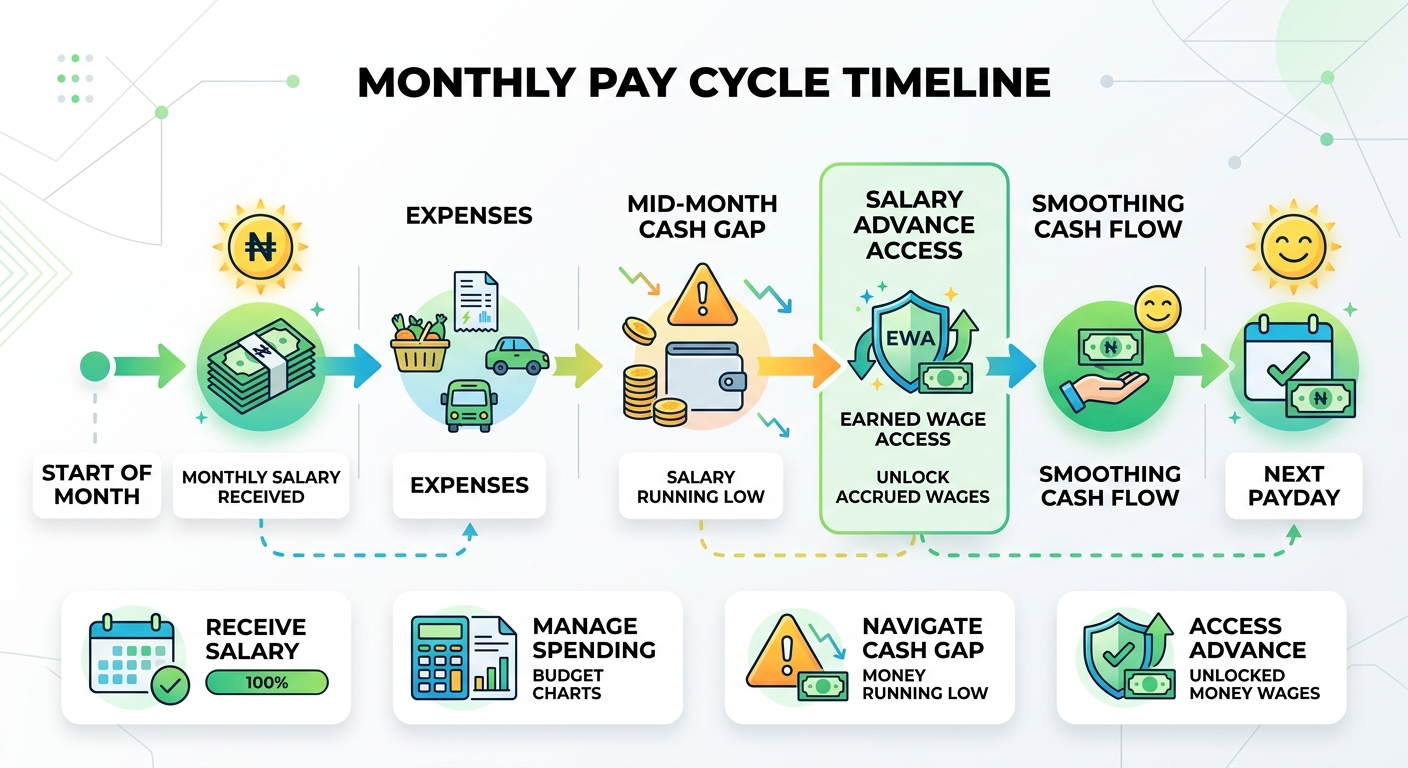
When Sapa Catches You Before Payday. It is the 18th of the month. Your account balance is reading something embarrassing. Rent is knocking, your data has finished, and your salary is still 12 days away.
Sapa does not respect your Excel budget or your savings goals. It shows up sharp-sharp, and suddenly you are calculating whether garri and groundnut can carry you to month-end.
This is the daily reality for millions of Nigerian salary earners — civil servants, NYSC corps members, bank workers, hospital staff, teachers, and everyday office workers. You have confirmed income coming. You just cannot touch it yet.
That is exactly the problem that
salary advance apps in Nigeria were built to solve.
But here is the costly mistake most Nigerians make: they treat salary advance apps like regular loan apps, or they rush in without reading the terms. By the time salary drops, the deduction hits harder than expected — and they are back to square one, only worse.
This guide breaks it down completely: what salary advance apps in Nigeria actually are, how they work, which ones are worth your time in 2025, what they will not tell you upfront, and how to use them without converting a temporary shortfall into a permanent debt cycle.
What Is a Salary Advance App? (It Is Not the Same as a Loan App)
Many Nigerians confuse the two, and the confusion is expensive. Let us clear this up immediately.
A
regular loan app lends you money from a pool of funds, at interest, based on your credit score or transaction history. You borrow ₦30,000, you repay ₦34,500 in 30 days. The money is not yours — it is theirs, and you are paying for access to it.
A
salary advance app works on a completely different principle. It gives you access to money you have already earned but have not yet received. If you earn ₦120,000 per month and it is the 15th of the month, you have technically "worked for" approximately ₦60,000 already. Salary advance apps in Nigeria let you access a portion of that earned-but-not-yet-paid wage.
Repayment comes directly from your salary when it drops — typically through an employer partnership or a direct debit mandate on your salary account.
This structure means:
-
Lower risk for the platform — repayment is near-guaranteed via payroll
-
Lower fees compared to traditional high-interest loan apps
-
Less psychological debt pressure — you are not borrowing from tomorrow, you are collecting today's earnings early
However — and this is critical — not every app that brands itself a "salary advance" actually operates this way. Several are simply loan apps with a rebranded name. The comparison table below will show you which is which.
How Salary Advance Apps Work in Nigeria — Step by Step
Step 1 — Employer Partnership or Income Verification
Legitimate earned wage access platforms partner directly with employers. Your company registers on the platform, and employees get access. Some apps skip this and verify income through bank statement analysis or consistent salary inflows on your account.
Step 2 — Access Your Earned Portion
Once verified, you request a portion of what you have earned in the current pay cycle. Most platforms cap this at 50% of your net monthly salary. Some go up to 70%.
Step 3 — Disbursement
Money hits your account — usually within minutes to a few hours, depending on the platform.
Step 4 — Automatic Repayment
When your employer processes payroll, the advance amount plus any service fee is automatically deducted before you receive the remainder. Some apps instead debit your salary account directly on your pay date.
This is a cleaner model than traditional borrowing — but you still need to know exactly what the costs are before you tap "Accept."
Top Salary Advance Apps in Nigeria 2025 — Full Comparison
| App |
Model |
Fee Structure |
Employer Partnership Required? |
Maximum Advance |
| Ropay |
True earned wage access |
Flat fee per withdrawal |
Yes |
Up to 50% of net salary |
| Earnipay |
True earned wage access |
Flat fee + optional subscription |
Yes |
Up to 50% of salary |
| Carbon (Paylater) |
Loan-based salary product |
Interest-based (varies by profile) |
No |
₦1M+ depending on score |
| FairMoney |
Salary loan via app |
Daily interest rate |
No |
Up to ₦1.5M |
| Specta by Sterling Bank |
Salary-linked personal loan |
Monthly interest |
Employer or Sterling salary account |
Up to ₦5M |
| QuickCheck |
AI-assessed salary loan |
Monthly interest |
No |
Up to ₦500,000 |
| Umba |
Salary loan via mobile app |
Interest-based |
No |
Up to ₦500,000 |
Key distinction: Apps like
Ropay and
Earnipay are genuine earned wage access platforms — they are advancing money you have already earned. Apps like
Carbon,
FairMoney, and
Specta are giving you a loan product that repays via your salary. The cost structure is fundamentally different. Always read the full fee disclosure before accepting any offer.
According to the
Central Bank of Nigeria's consumer protection framework, all licensed digital lenders must disclose full interest rates and fees before disbursement. If any app hides this information, that is a regulatory red flag.
Salary Advance Apps vs. Regular Loan Apps — Which One Actually Wins?
| Category |
Salary Advance App |
Regular Loan App |
| What you are accessing |
Money you already earned |
New debt |
| Typical cost |
Low flat fee — ₦500 to ₦2,000 |
5–30% monthly interest |
| Repayment method |
Auto-deducted from salary |
Manual repayment or direct debit |
| Credit check required |
Often no — employer is the guarantee |
Usually yes |
| Risk of over-borrowing |
Lower — capped at earned wages |
Higher — amounts can escalate |
| Availability |
Limited to registered employers (true platforms) |
Available to almost any BVN holder |
| Speed |
Minutes to hours |
Minutes to 24 hours |
The honest verdict: If your employer is registered on a salary advance platform, use it — it is almost always cheaper and structurally safer than a loan app. If your employer has not registered, you will default to loan-based alternatives, and that is where careful fee analysis becomes non-negotiable.
For a broader look at how Buy Now Pay Later tools compare for Nigerian consumers, read our breakdown at
SharpCollect's BNPL guide — it covers the full picture of flexible credit options available in 2025.
Who Actually Qualifies? Requirements Most Apps Will Not Tell You
Many salary advance apps in Nigeria advertise broadly but restrict quietly. Here is what verification typically looks like:
For Employer-Based Platforms (Ropay, Earnipay):
- Your employer must be an active registered partner on the platform
- Minimum employment tenure of 3–6 months with that employer
- Verifiable salary account — the specific account your employer pays into
- NYSC members: some platforms explicitly accept NYSC monthly allowance — confirm this before applying, as not all do
For Loan-Based "Salary Advance" Apps (Carbon, FairMoney, Specta):
- Active bank account with consistent salary inflows for 3–6 months minimum
- BVN linked to the account
- Minimum salary threshold — some apps set this at ₦30,000 net monthly
- No outstanding defaults on other platforms in the credit bureau
Civil Servants specifically: Federal and state civil servants often have access to government-linked salary advance arrangements through their ministry or through commercial banks like GTBank, Access Bank, First Bank, and UBA — where your IPPIS payroll is domiciled. Speak to your HR or accounts department before downloading any third-party app. The bank route is frequently cheaper and more straightforward.
Hidden Fees and Traps That Will Surprise You
Even salary advance apps in Nigeria that market themselves as the ethical alternative carry traps. These are the ones to watch:
Trap 1 — Subscription Fees Charged Before You Withdraw Anything
Some platforms charge a monthly or annual subscription just to access the service. Calculate the annual subscription cost against your expected usage. If you use the advance twice a year, is the subscription worth it?
Trap 2 — "Flat Fee" That Annualises Into Triple-Digit APR
A ₦1,500 flat fee on a ₦15,000 advance for 15 days sounds cheap. Do the maths: that is 10% for two weeks, or roughly 260% annualised. Flat fees are not automatically friendly to your pocket.
Trap 3 — The Rollover Habit
Because repayment is automatic, many workers take a new advance the moment the previous one clears — every single month. This means you are permanently living 50% behind your salary. It is a debt cycle dressed in clean UX.
Trap 4 — Undisclosed Deductions at Disbursement
Some apps process the advance at a fee that is not fully visible until the money lands in your account and is lower than expected. Always confirm the exact naira amount you will receive and the exact amount that will be deducted on payday — before accepting.
Trap 5 — Personal Liability After Employment Exit
If you leave a job while an advance is outstanding, many platforms hold you personally liable for the full balance. The advance does not dissolve with your resignation letter. Check the terms on this specifically.
The
EFInA Access to Finance Survey consistently shows that hidden fees are the primary reason Nigerians have negative experiences with digital credit. Read before you borrow — every single time.
The Real Numbers: What Salary Advance Actually Costs vs. Alternatives
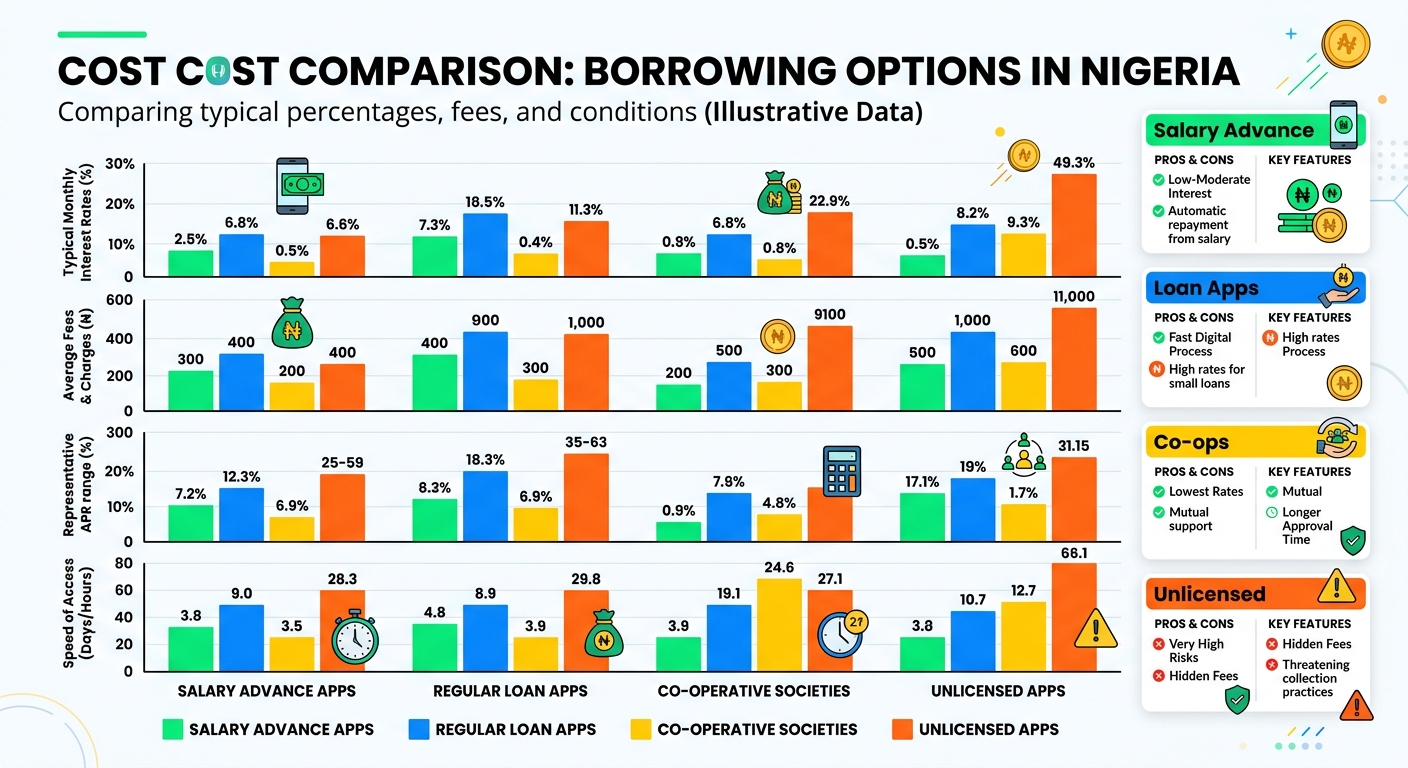
To make this concrete, here is a real-world cost comparison on a ₦20,000 need for 15 days:
| Source |
Amount Borrowed |
Fee / Interest |
Total Repaid |
Effective Monthly Cost |
| Earnipay (true advance) |
₦20,000 |
₦500 flat |
₦20,500 |
~2.5% |
| GTBank Salary Loan |
₦20,000 |
~₦600 |
₦20,600 |
~3% |
| Co-operative Society |
₦20,000 |
₦200–₦400 |
₦20,200–₦20,400 |
~1–2% |
| Carbon / FairMoney |
₦20,000 |
₦1,800–₦3,000 |
₦21,800–₦23,000 |
~9–15% |
| Unlicensed loan app |
₦20,000 |
₦4,000–₦8,000 |
₦24,000–₦28,000 |
20–40% |
The numbers tell you everything. The source of your credit determines the cost of your credit.
According to
Nairametrics' consumer lending analysis, Nigerians lose billions of naira annually to high-interest digital loans that could have been replaced by lower-cost salary advance apps in Nigeria or bank-linked products — primarily because of speed bias: people take whatever disburses fastest without comparing costs.
How to Use Salary Advance Wisely — So It Does Not Become a Monthly Trap
Rule 1 — Define "Emergency" Before You Open the App
Rent, hospital bills, school fees, emergency transport — these qualify. Weekend plans, new clothes, or data top-ups do not. If the expense can wait 12 days, wait.
Rule 2 — Take Only What You Need
Qualifying for 50% of your salary does not mean you should take 50%. Take the minimum amount that solves the specific problem in front of you.
Rule 3 — Treat Monthly Usage as a Warning Signal
If you are using salary advance apps in Nigeria every single month, your expense structure is outpacing your income — and no advance will fix that. It is a budget problem wearing a cash flow costume.
Rule 4 — Build a ₦10,000 Emergency Buffer
Even ₦5,000–₦10,000 sitting in PiggyVest or Cowrywise can prevent you from ever needing an advance for minor emergencies. Build it gradually — ₦1,000 per week if necessary.
Rule 5 — Calculate the Naira Cost Every Time
Before accepting any offer from salary advance apps in Nigeria, compute the exact naira cost. A ₦2,000 fee on a ₦20,000 advance is 10%. Is that worth it for your specific situation? Make it a conscious decision, not a reflex tap.
What If Your Employer Is Not Registered? Here Are Your Options
Most Nigerian employers have not registered on any salary advance platform. If yours has not, these are your practical alternatives:
Option A — Your Salary Bank's Instant Loan Product
GTBank, Access Bank, UBA, First Bank, and Zenith all offer instant salary-linked loans to customers who receive salary through them. Rates typically run 2–4% monthly — significantly lower than most consumer loan apps. Check your bank's mobile app first before turning to third-party salary advance apps in Nigeria.
Option B — Workplace Co-operative Society
This is the most underrated financial tool in Nigeria, particularly in government offices. Co-operative societies offer salary-linked advances at 1–2% flat interest per month — sometimes even lower. Ask your HR whether your workplace has one registered.
Option C — CBN-Licensed Loan Apps
If you must use a third-party app, stick to CBN-licensed operators: Carbon, FairMoney, Specta by Sterling, and similar regulated platforms. Avoid unlicensed apps entirely — they have no compliance obligations and can report you to BVN-linked credit bureaus without due process.
Option D — Advocate for Employer Onboarding
Platforms like Earnipay and Ropay actively onboard employers at no cost to the company. You can request that your HR department signs up. It benefits every employee and costs the organisation nothing. This is the cleanest long-term solution.
For a full comparison of flexible credit tools available to Nigerians in 2025, including BNPL options that do not require salary verification, visit
SharpCollect's credit resource hub.
Final Verdict — Smart Move or Debt Trap?
Salary advance apps in Nigeria, used correctly, are one of the most sensible financial tools available to the Nigerian salary earner in 2025. They are not borrowing from your future — they are collecting your present. That distinction has real financial value.
But available and wise are two very different words.
Use salary advance apps in Nigeria for genuine emergencies. Take only what you need. Understand the full fee before you accept. Do not make it a monthly routine. If you are advancing every month, the app is not your problem — your budget structure is.
The best salary advance apps in Nigeria — particularly Earnipay and Ropay for employer-based earned wage access, and Specta or Carbon for loan-based alternatives — all have legitimate use cases. None of them are automatically good or bad. Your usage pattern is what determines which category you fall into.
The goal is not to become expert at borrowing cheaply. The goal is to build a financial cushion solid enough that the 18th of the month feels like any other day.
Start there. One month at a time.
Frequently Asked Questions
Are salary advance apps in Nigeria safe to use in 2025?
Yes — provided you use CBN-licensed platforms. Apps like Earnipay, Ropay, Carbon, FairMoney, and Specta by Sterling Bank are regulated and required to disclose all fees before disbursement. Avoid any salary advance app that is not listed on the CBN's approved digital lender registry. The biggest risk is not safety from fraud — it is falling into a monthly rollover habit that quietly drains your take-home pay.
How much can I get from salary advance apps in Nigeria?
For true earned wage access platforms like Earnipay and Ropay, the typical maximum is 50% of your net monthly salary — because that represents what you have approximately earned by mid-month. Loan-based "salary advance" apps like Carbon and FairMoney can offer significantly higher amounts (up to ₦1.5M or more), but these are loan products with interest rates, not earned wage access. Always confirm which model you are using before you apply.
What happens if my salary is delayed and I have an outstanding salary advance?
This depends on the platform. For employer-based earned wage access apps (Ropay, Earnipay), the repayment is tied to payroll processing — if salary is delayed, repayment is typically delayed too, and you should not be penalised for an employer-side delay. For loan-based apps (Carbon, FairMoney), your repayment date is fixed regardless of when your salary arrives. Contact the app's customer support immediately if you anticipate a delay — most regulated platforms have a short grace period before penalties apply. Document everything in writing.