

Everything looked legitimate. The app had a polished icon, a clean interface, and a five-star rating in the Play Store. The loan dropped in two hours. You told yourself you had done your research.
Then repayment day arrived — and so did the voice messages sent to your aunties, your line manager, and three people you once called in 2019. Messages describing you, by name, as a fraudster.
This is not a rare horror story. Thousands of Nigerian borrowers who had no idea how to tell the difference between a genuine CBN licensed loan app Nigeria and a predatory operation wearing a professional mask.
The good news? Verifying a lender takes less than five minutes. Most Nigerians simply have never been shown how. That changes right now.
CBN vs FCCPC vs SEC — Who Actually Licenses What?
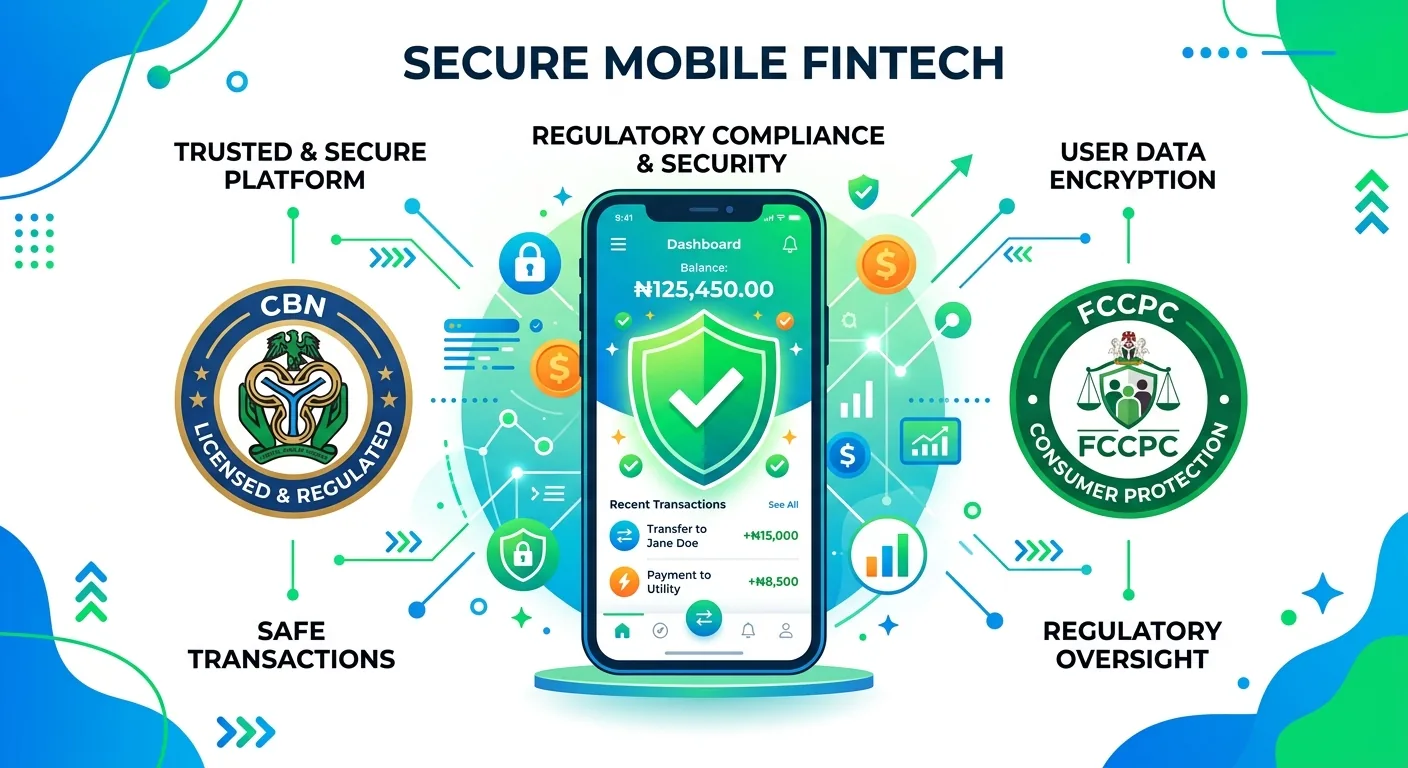
Before you begin verifying any lender, you need clarity on which regulator is responsible for which type of institution. Scammers deliberately exploit the confusion between these bodies.
Central Bank of Nigeria (CBN)
The CBN regulates commercial banks, microfinance banks, finance companies, and payment service providers. If a company presents itself as a “bank” or “microfinance bank” — the CBN must have issued its license. Any claim to banking status without a CBN license is illegal.
Website: www.cbn.gov.ng
Federal Competition and Consumer Protection Commission (FCCPC)
The FCCPC specifically regulates digital money lenders. In 2022, the FCCPC launched the Limited Interim Regulatory/Registration Framework (LIRFF), which requires every app that lends money digitally — whether CBN-licensed or not — to register and receive FCCPC approval before operating legally in Nigeria.
Website: www.fccpc.gov.ng
Securities and Exchange Commission (SEC)
SEC governs investment products and capital markets. If a platform is offering you returns on money you deposit — SEC is the relevant regulator. SEC does not oversee loan apps or digital lenders.
The Simple Rule Every Nigerian Should Memorise
- App lends money digitally → Must appear on FCCPC approved list
- App operates as a microfinance bank → Must hold a CBN license
- App does both → Must appear on both lists
If a lender appears on neither official list? Close the app and delete it.
Step-by-Step: How to Verify a Loan App on CBN’s Official Website
This is the exact process most Nigerians have never been walked through — and it is the single most powerful tool you have to confirm whether any lender is genuinely among the CBN licensed loan apps Nigeria or not.
Step 1: Open your browser and navigate to www.cbn.gov.ng
Step 2: Use the site’s search bar. Enter the legal company name of the lender — not the app name. These are often different.
Step 3: Navigate through “Financial Policy and Regulation” → “Other Financial Institutions” — this is where microfinance banks and finance companies are formally listed by the CBN.
Step 4: The CBN publishes a downloadable PDF of all currently licensed institutions on a periodic basis. Search the phrase “CBN licensed institutions list 2025” directly on the CBN website and download the most current version.
Step 5: If the company name appears — confirm what category of license it holds. A microfinance bank license operates differently from a finance company license, though both are legitimate and regulated.
Step 6: If the company name does not appear anywhere in the CBN records — stop. No sleek design, glowing testimonials, or urgent loan offer changes the fundamental fact that an unlicensed lender has no regulatory accountability whatsoever.
Pro Tip: Check the Legal Company Name, Not the App Name
Many loan apps operate under a parent company name that differs entirely from the app name displayed on your phone. An app called “SwiftNaira” might legally be registered as “Omega Finance Solutions Limited.” Always open the app’s Terms and Conditions or “About” section, find the registered company name, and search that name — not the brand name — on the CBN website.
How to Check the FCCPC Digital Lending Register
The FCCPC register is your second — and equally critical — verification step. For loan apps specifically, this is sometimes even more relevant than the CBN database, because many digital lenders are not microfinance banks but are still legally required to hold FCCPC approval.
Step 1: Go to www.fccpc.gov.ng
Step 2: Look for the section labelled “Digital Lending” or use the search function on the site to look for “Limited Interim Regulatory Framework.”
Step 3: The FCCPC maintains a regularly updated list of approved digital lenders. Download and review the current version.
Step 4: Search the list for the loan app or its parent company name.
Step 5: If you cannot locate the current list directly on the site, the FCCPC’s official X (Twitter) handle regularly posts announcements about newly approved lenders and newly banned apps. These announcements are an important secondary source.
The FCCPC has removed dozens of illegal apps from Nigerian app stores and published their names publicly. Before borrowing from any app that is not an established household name, this two-minute check is non-negotiable.
Red Flags When a “Licensed” Lender Is Still Lying
Here is something that catches even careful Nigerians off guard: some predatory apps actively claim to be licensed without actually holding any valid registration. They paste fabricated license numbers into their Terms and Conditions and app store descriptions to create an impression of legitimacy.
Know what to look for.
They Cannot Provide a Verifiable License Number
Every genuine entry among CBN licensed loan apps Nigeria carries a specific, publicly searchable license number. Legitimate lenders state this openly — something like: “Licensed by the Central Bank of Nigeria, RC No. XXXXXXX” or “Approved by the FCCPC under the LIRFF, Reference No. XXXXXXX.” Vague statements like “we are fully licensed and regulated” with no numbers attached are worthless and almost always deliberate misdirection.
They Demand Contact List Access Before Disbursing Any Loan
This is the single clearest red flag of all. CBN consumer protection rules and FCCPC regulations explicitly prohibit approved digital lenders from accessing a borrower’s contact list. If an app requests this permission before — or as a condition of — disbursing your loan, it does not matter what licensing claims it makes. It is operating in direct violation of regulatory standards.
No Physical Nigerian Address and No Working Customer Service Line
Real CBN licensed and FCCPC-approved companies maintain registered Nigerian offices. If you cannot find a verifiable Lagos, Abuja, or Port Harcourt address — and if their customer service number either does not exist or goes unanswered — you are looking at a ghost operation.
Upfront Fees Required Before Loan Disbursement
No legitimate lender regulated by the CBN or FCCPC will require you to pay an “insurance fee,” “activation fee,” or “processing charge” before your loan is released to you. This is a textbook advance-fee fraud pattern. Regulated lenders deduct any legitimate fees from the loan amount itself, or include them transparently in your repayment schedule.
The 5 Questions to Ask Before You Install Any Loan App
Treat this as your personal borrowing checklist. Before your thumb touches “Install” on any loan app:
Question 1: What is the legal registered company name?
Not the app name. The actual name registered with the Corporate Affairs Commission. Find it in the Terms and Conditions.
Question 2: Does this company appear on the CBN licensed institutions list?
Visit www.cbn.gov.ng and search. Three minutes maximum.
Question 3: Is this app on the FCCPC approved digital lenders register?
Visit www.fccpc.gov.ng and cross-check. Another two minutes.
Question 4: Does the app request access to your contact list?
If the answer is yes — delete the app immediately and do not look back. This permission is explicitly banned for all legitimate CBN licensed loan apps Nigeria and FCCPC-approved lenders.
Question 5: What are real borrowers saying publicly?
Search the app name on X (Twitter) and Google, adding words like “scam,” “harassment,” “blackmail,” or “review Nigeria.” If dozens of Nigerians are sharing stories of contact harassment or fraudulent charges — that is your definitive answer.
Five questions. Five minutes. Potentially months of harassment, financial stress, and credit damage avoided.
What Happens If You Borrow From an Unlicensed Lender?
Some borrowers reason: “I will just repay on time — so what is the risk?” Here is the reality that reasoning ignores.
Your BVN Is Now in Unregulated Hands
Unlicensed loan apps have demonstrably sold borrower data — including BVN details — to third-party brokers. Your BVN is the master key to every bank account registered in your name across Nigeria. Once it enters the wrong database, you lose control over your financial identity in ways that extend far beyond one loan.
Contact Harassment Begins — Often Before You Miss a Payment
Illegal apps harvest your full phone contact list on installation. If repayment becomes difficult — sometimes even if you pay and the app’s system does not update correctly — automated voice blasts and WhatsApp messages go to your contacts, your employer, and your family. The messages are designed to cause maximum social humiliation.
Interest Compounds With Zero Legal Ceiling
Unlicensed lenders are not bound by CBN consumer protection standards or FCCPC interest rate guidelines. There is no regulatory limit on what they can charge. Borrowers have reported debts tripling within weeks through penalty stacking that no regulated lender would be permitted to apply.
You Have No Meaningful Legal Recourse
You cannot report an unlicensed lender to the CBN — because the CBN never licensed them. You cannot invoke FCCPC protection — because they are not on the FCCPC register. Police reporting remains an option but resolves digital financial crimes slowly, if at all. You have been abandoned by the regulatory framework that was built to protect you — because you borrowed outside it.
Verified CBN Licensed Loan Apps Nigeria — 2026 Reference List
These are established digital lenders with verifiable regulatory standing as of 2025. Treat this as a starting point for your own verification — always personally confirm current status before borrowing, as licenses and registrations are updated periodically.
FairMoney Microfinance Bank — CBN-licensed microfinance bank and one of the most widely used CBN licensed loan apps Nigeria offers to everyday borrowers.
Carbon (formerly Paylater) — Operates as Carbon Microfinance Bank under a CBN microfinance banking license.
Branch International — Registered digital lender operating in compliance with FCCPC regulations.
Renmoney Microfinance Bank — CBN-licensed microfinance bank with both a mobile app and physical branch presence across Nigeria.
Palmcredit (Newedge Finance Limited) — Registered under the FCCPC digital lending framework.
ALAT by Wema Bank — Backed directly by Wema Bank, a full CBN-licensed commercial bank with decades of regulatory standing.
Kuda Bank — CBN-licensed microfinance bank that provides both savings and lending products digitally.
Appearing on this list does not indicate that any of these lenders offers the cheapest rates, the largest limits, or the best customer experience. What it means is that they are regulated — and that if something goes wrong, you have a legitimate regulatory body to report them to. That protection matters more than a low headline interest rate from an unknown app.

Comment (1)
Opay is not on the lists