

POSTED BY:
COMMENTS:
0
POST DATE:
You earn. Sapa takes it. Repeat.
If that sentence just described your financial life in 2025, you are not alone. Millions of salary earners, NYSC corps members, civil servants, and everyday Nigerian workers wake up on the 5th of every month wondering where last month's salary disappeared to. The rent took a chunk. Transport swallowed some. Airtime, data, small chops here and there — and before you blink, balance is zero.
But here is the thing nobody tells you: the problem is not that you earn too little. The problem is that your money has no instruction before it lands in your account.
Automated savings apps Nigeria workers rely on fix that problem. Sharp-sharp.
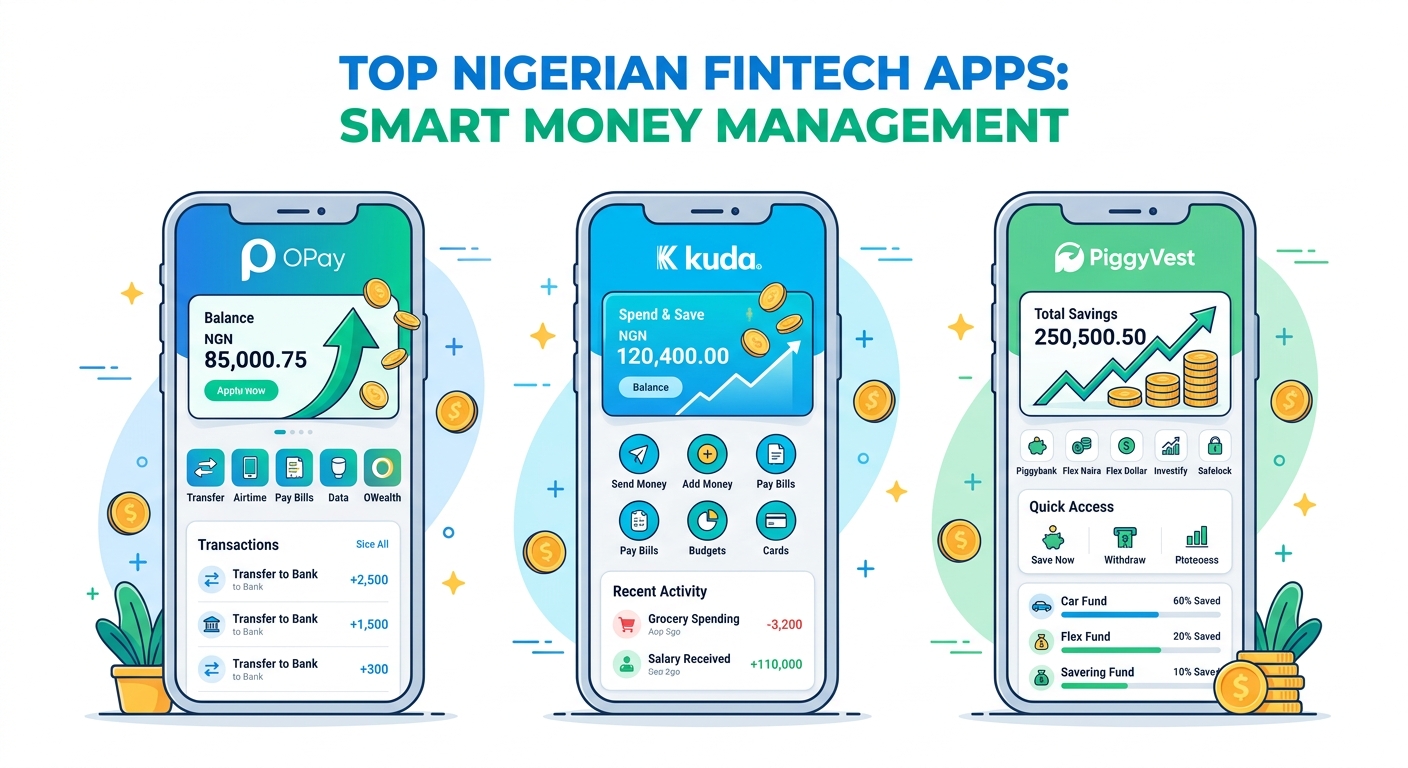
This guide compares three of the most popular automated savings apps Nigeria salary earners are actually using right now — OPay, Kuda, and PiggyVest — and breaks down exactly which one makes the most sense depending on your income, your lifestyle, and your savings goal.
Why Automated Savings Is the Secret Weapon of Low-Income Earners in Nigeria
Let us be honest. "I will save after I spend" has never worked. Not for your parents. Not for you. Not for anyone.
The human brain is wired to spend what it sees. Once your salary hits your account and you can see that number on your screen, every expense that has been waiting in the queue suddenly becomes urgent. Your landlord's reminder. Your sibling's request. The shoe you have been eyeing since January.
Automated savings removes the temptation completely. Instead of you deciding to save, the app saves for you before you can spend it. The money moves automatically — daily, weekly, or monthly — from your account into a savings vault or wallet the moment your salary lands or on a schedule you set.
For someone earning ₦50,000 to ₦150,000 monthly, this is the difference between ending the year with ₦0 in savings or ending the year with ₦60,000 to ₦180,000 sitting quietly, earning interest, waiting for when you truly need it.
The three automated savings apps Nigeria salary earners are relying on most heavily right now are OPay, Kuda, and PiggyVest. Each one works differently. Each one serves a different type of person. Here is exactly how they stack up.
Quick Overview: OPay vs Kuda vs PiggyVest at a Glance
| Feature | OPay | Kuda | PiggyVest |
|---|---|---|---|
| App Type | Digital Wallet + Savings | Digital Bank | Dedicated Savings Platform |
| Minimum Savings | ₦100 | ₦50 | ₦100 |
| Interest Rate (approx.) | Up to 15% p.a. | Up to 15% p.a. | Up to 10–13% p.a. |
| Automated Savings | Yes (OPay Save) | Yes (Spend+Save, Pocket) | Yes (Safelock, Flex Save, Targets) |
| Early Withdrawal | Yes (flexible) | Yes (flexible) | Restricted on Safelock |
| CBN Licensed | Yes | Yes (Microfinance Bank) | Yes (SEC Regulated) |
| Best For | Quick, low-pressure savers | Budget-conscious bankers | Disciplined, goal-based savers |
| Monthly Charges | None | None | None |
| Salary Receive | Yes | Yes | No |
This table alone tells you something important: no single app dominates every category. The right pick among these automated savings apps Nigeria users trust depends entirely on your personal situation.
OPay Savings — For the Nigerian Who Wants Zero Stress and Instant Access
OPay is already on almost every Nigerian's phone. You use it to receive money, pay bills, and buy airtime. So the fact that it also has a savings feature built right inside the same app makes it the lowest-friction option available among all automated savings apps Nigeria currently offers.
How OPay Save Works
OPay's savings feature allows you to set aside money directly within your OPay wallet. You choose a target amount, a duration, and the app locks a portion of your balance automatically. You can set it to deduct a fixed amount daily or weekly. Interest is credited back to your wallet at the end of the savings cycle.
The Actual Numbers:
OPay Save currently advertises interest rates of up to 15% per annum. On a ₦50,000 balance locked for 12 months, that is approximately ₦7,500 in interest returned to your wallet — money you did nothing to earn except leave it there.
Why OPay Works for Low-Income Earners
- No need to download a separate app — savings happens where your money already lives
- The ₦100 minimum means even on your worst week, you can still put something away
- Flexible withdrawal means if a genuine emergency arrives — medical bill, transport crisis — you can access your money without penalties
- The interface is simple enough that a first-time smartphone user can set it up in under three minutes
The Hidden Risk With OPay Savings
Because your savings and spending wallet live in the same app, the temptation to "just borrow small" from your savings when your balance is low is very real. OPay is the easiest to save with — and also the easiest to unsave with. If your savings discipline is shaky, this flexibility can work against you.
According to the CBN's consumer finance research, Nigerians who keep savings and spending in the same account are significantly more likely to draw down savings during non-emergency periods. This is not a character flaw. It is simply how proximity to money works.
Best Suited For: NYSC corps members, casual workers, daily wage earners, and first-time savers who want to start small without pressure.
Kuda Bank — For the Budget-Conscious Nigerian Who Hates Paying Bank Charges
Kuda calls itself "the bank of the free." For anyone who has watched their GTBank, First Bank, or Access Bank account balance quietly drain through maintenance fees, SMS charges, and card renewal costs, that tagline hits differently.
Traditional commercial banks in Nigeria charge between ₦1,000 and ₦2,500 in combined monthly fees and SMS alerts. On a ₦60,000 salary, that is up to 4.2% of your income gone before you spend a single kobo intentionally. Kuda eliminates most of those charges — making it one of the most cost-effective automated savings apps Nigeria salary earners can switch to.
How Kuda Savings Works
Kuda offers two main savings features: Spend+Save and Pockets.
- Spend+Save is fully automated: every time you make a transaction from your Kuda account, the app automatically saves a small percentage you pre-set. Set it at 5%, spend ₦2,000 on groceries, and ₦100 moves to savings immediately. You do not see it leave. You do not miss it.
- Pockets allows you to create named savings goals — Rent Fund, Emergency Stash, Christmas Money — and automate contributions into each on a daily, weekly, or monthly schedule.
The Actual Numbers:
Kuda pays interest rates hovering around 10–15% per annum depending on the product and CBN monetary policy adjustments. This is significantly more competitive than traditional savings accounts at commercial banks, which often pay as low as 1.25% per annum.
Why Kuda Works for Low-Income Earners
- Zero monthly bank charges — saving you ₦1,000–₦2,500 per month compared to legacy banks
- Spend+Save captures savings even when you forget to save intentionally, because you are always spending
- Free transfers (a set number monthly) mean your salary flows without fees eating into it
- Full banking functionality means Kuda can completely replace your traditional account
The Limitation With Kuda
Kuda requires a BVN and standard documentation to open — same as any legitimate bank. The app is more feature-rich than OPay's savings tool, which can feel slightly overwhelming if all you want is a simple savings button. More critically, unlike PiggyVest, there is no hard lock on your money. If you lack discipline, you can move savings back to your spending balance in seconds.
Best Suited For: Salary earners, civil servants, remote workers, and anyone who wants to completely replace their traditional bank account while automating savings on the side.
PiggyVest — For the Disciplined Saver Who Needs Their Money Locked Away From Themselves
PiggyVest is not playing games. It was literally built to stop you from touching your own money.
If you have tried saving before and always failed — if you keep raiding your savings "just this once" and end the month with nothing to show — PiggyVest was designed specifically for people like you. It is the strictest of all automated savings apps Nigeria currently provides.

How PiggyVest Works
PiggyVest has four main products, three of which are directly relevant for everyday Nigerian savers:
- PiggyBank — Your regular automated savings. Set a daily, weekly, or monthly amount and the app deducts it automatically. You can only withdraw at a scheduled break date, typically quarterly. Attempt to break early and you forfeit a portion of your earned interest.
- Safelock — You deposit money and it is completely locked until a specific future date you choose. No early withdrawal. None. The money is frozen. This is the "no-be-me-again" account for chronic savings raiders who need an external force to hold them accountable.
- Flex Save — A more flexible option that allows you to withdraw up to twice a month without losing interest. Lower interest rate than Safelock, but higher freedom.
The Actual Numbers:
PiggyVest Safelock currently offers rates reaching up to 13% per annum. On a ₦100,000 Safelock held for 12 months, that is ₦13,000 returned — no charges deducted. PiggyBank earns slightly less. Flex Save earns less than both, but you retain access.
PiggyVest's own published data shows that users who complete a full Safelock cycle save an average of 3x more than users who rely on flexible savings tools alone. The lock itself is the feature.
Why PiggyVest Works for Low-Income Earners
- Safelock removes the option to fail — the app cannot release your money before the date you set, regardless of how urgent the situation feels
- Goal-based saving with named targets makes saving feel purposeful, not punishing
- Even ₦1,000 can start a Safelock and grow quietly in the background
- The psychological commitment of locking money creates stronger savings habits over time
The Hard Truth About PiggyVest
PiggyVest is not a bank. You cannot receive your salary into PiggyVest or use it for daily transactions. You will still need OPay, Kuda, or a traditional bank for everyday banking. PiggyVest is purely a savings and mild investment layer sitting on top of your existing accounts.
Also, the Safelock penalty is real. If you lock ₦80,000 for 6 months and a genuine emergency arrives at month three, the money is not coming out. Know this before you commit funds.
Best Suited For: Workers who have tried and failed at saving before, goal-focused savers targeting a specific deadline, and anyone who needs the app to enforce more discipline than their own willpower currently allows.
Which App Wins for Your Situation? A Decision Framework for Nigerian Earners
Here is a practical guide to choosing the right one among the automated savings apps Nigeria has on offer in 2025:
Choose OPay if:
- You are already using OPay for daily transactions
- You earn irregularly — daily wages, casual work, small contracts
- You are a first-time saver and want zero complications
- You need access to savings if an emergency strikes
Choose Kuda if:
- You receive a monthly salary or predictable regular income
- You want to replace your traditional bank and save simultaneously
- Bank charges have been silently eating your income for years
- You want savings to happen every time you spend, with zero manual effort
Choose PiggyVest if:
- You have tried saving before and always broken the plan
- You are saving for a specific goal with a hard deadline — school fees, rent renewal, JAMB registration
- You want the highest interest rates on locked savings
- You need the app to be stricter than your own willpower
The Combination Sharp Nigerians Are Actually Using
Many financially aware Nigerians combine Kuda as their main bank with PiggyVest as their locked savings vault. Salary lands in Kuda. An automated transfer immediately moves a fixed amount to PiggyVest Safelock. What stays in Kuda is the spending budget. The Safelock money is invisible and untouchable.
This two-layer approach removes decision fatigue entirely and is the most effective framework among all automated savings apps Nigeria strategies available in 2025. If you are serious about building a financial cushion this year, this combination is where to start.
How to Set Up Automated Savings in Under 5 Minutes
This process works for any of the three apps:
- Download the app — OPay, Kuda, and PiggyVest are all available on Google Play Store and Apple App Store. Free to download, free to use.
- Complete your registration — You need your BVN, a valid phone number, and a government-issued ID for Kuda and PiggyVest. OPay's process is slightly simpler and faster.
- Fund your account — Transfer your first savings deposit. Even ₦500 works. The amount is not the point yet; the habit is.
- Set your savings schedule — Choose daily, weekly, or monthly based on when your income arrives. Daily wage workers should pick daily. Salary earners should pick monthly, timed 24 hours after payday.
- Name your savings goal — "December Rent." "Emergency Fund." "New Phone by June." Naming a goal makes you significantly less likely to break it early.
- Enable auto-debit — This is the crucial step. Turn on automatic deduction so the app saves without waiting for you to remember. This is what separates people who build genuine savings from people who merely intend to.
- Set a payday reminder — The day salary lands, review your savings settings before spending anything else. Adjust if income changed. Otherwise, leave it running.
Seven steps. Five minutes. Your money finally has an instruction — and you are now using automated savings apps Nigeria the way they were designed to be used.
Common Mistakes Nigerians Make With Savings Apps (And How to Avoid Them)
Mistake 1: Setting the Savings Amount Too High From Day One
If you earn ₦80,000 and automate ₦40,000 into savings, you will break the plan by week two when you cannot cover transport. Start with 10% of your income — ₦8,000 in this case. Increase by 5% each quarter as you adjust your lifestyle.
Mistake 2: Using One App for Both Spending and Savings
When your spending money and savings sit in the same place, the savings always lose. Separate them physically across different apps. This single change dramatically improves savings outcomes.
Mistake 3: Saving Without Naming a Goal
"I am just saving" is not a savings strategy — it is delayed spending. Give every savings vault a name and a target date. The name creates a psychological barrier against raiding it when temptation strikes.
Mistake 4: Turning Off Automation During Difficult Months
This is the exact moment automation matters most. If you pause the plan every month it feels tight, you will never actually accumulate anything meaningful. The discipline is in keeping it running when it hurts.
Mistake 5: Not Reading the Withdrawal Terms Before Locking Money
PiggyVest Safelock is serious. If you lock ₦60,000 for 6 months and a genuine emergency arrives on month two, the money is not accessible. Read the terms of each product before you commit — especially on the stricter automated savings apps Nigeria provides, where locking conditions are enforced without exceptions.
Final Verdict: The Best Automated Savings Apps Nigeria Has in 2025 — Start Today
There is no universally "best" app. There is only the best app for your income, your discipline level, and your savings goal.
If you are undisciplined — PiggyVest Safelock. Let it hold your money hostage until the date arrives.
If you want your bank to do double duty — Kuda with Spend+Save activated from today.
If you just want to start without overthinking — open OPay Save right now, put in ₦1,000, and set a weekly deduction of ₦500.
The common thread across all three automated savings apps Nigeria salary earners are using is this: automated savings beats manual savings every single time. The moment money moves before you can touch it, the game changes entirely.
Your December self, your 2026 self, the version of you that needs emergency cash without calling a loan app — that person is built by the small automated decisions you make this month. Sapa is real. But building a genuine financial cushion on a modest Nigerian income is also real — and these three automated savings apps Nigeria workers trust are the practical tools to do it.
They are free to download, free to use, and the setup takes less time than watching one TikTok video.
Sharp-sharp. Go start. Today.
Frequently Asked Questions About Automated Savings Apps in Nigeria
Are automated savings apps Nigeria platforms safe to use with my real money?
Yes — OPay, Kuda, and PiggyVest are all regulated by Nigerian financial authorities. Kuda operates under a CBN Microfinance Bank license, OPay holds a CBN Mobile Money Operator license, and PiggyVest is SEC-regulated. Your funds on these platforms are not held informally. That said, it is good practice to start with smaller amounts as you build familiarity with each platform, and to verify current regulatory status directly with CBN or SEC if you have concerns.
Can I use more than one of these automated savings apps Nigeria at the same time?
Absolutely — and many sharp Nigerians do exactly that. The most effective combination widely recommended in 2025 is using Kuda as your primary bank account for salary receipt and everyday spending, while simultaneously running a PiggyVest Safelock for your locked savings target. OPay can serve as a third layer for flexible, accessible savings you may need on short notice. Running two or three of these platforms together is not complicated and significantly improves your overall savings outcomes.
What is the minimum amount I need to start using automated savings apps Nigeria offers?
Very little. OPay Save and PiggyVest both allow you to start with as little as ₦100, and Kuda allows savings from as low as ₦50. There is no meaningful financial barrier to starting. The most important step is not the amount — it is enabling the auto-debit feature so saving happens without requiring your daily decision. Starting with ₦500 or ₦1,000 on any of these platforms today is more valuable than waiting until you have a "better" amount to save.
Interest rates quoted in this article reflect approximate figures as of Q1 2025 and may be updated by providers in response to CBN monetary policy changes. Always verify current rates directly within each app before committing funds. OPay, Kuda, and PiggyVest are regulated financial platforms operating under CBN and SEC oversight in Nigeria.
