

Early Loan Repayment Nigeria: The Part FairMoney, Carbon & Branch Hope You Never Calculate
Your salary just entered. You have an active loan and the urge to clear it immediately feels like discipline. It feels like freedom.
But one question stands between you and a smart financial move: will early loan repayment in Nigeria actually reduce what you owe — or will you pay the exact same amount whether you rush or not?
The answer depends entirely on how your lender structured your loan. Get it wrong and you have emptied your account, saved exactly ₦0, and you are already calculating which loan app to open next. This guide breaks down everything Nigerian borrowers need to know before hitting "Pay Now."
How Nigerian Loan Apps Price Interest — This Changes Everything
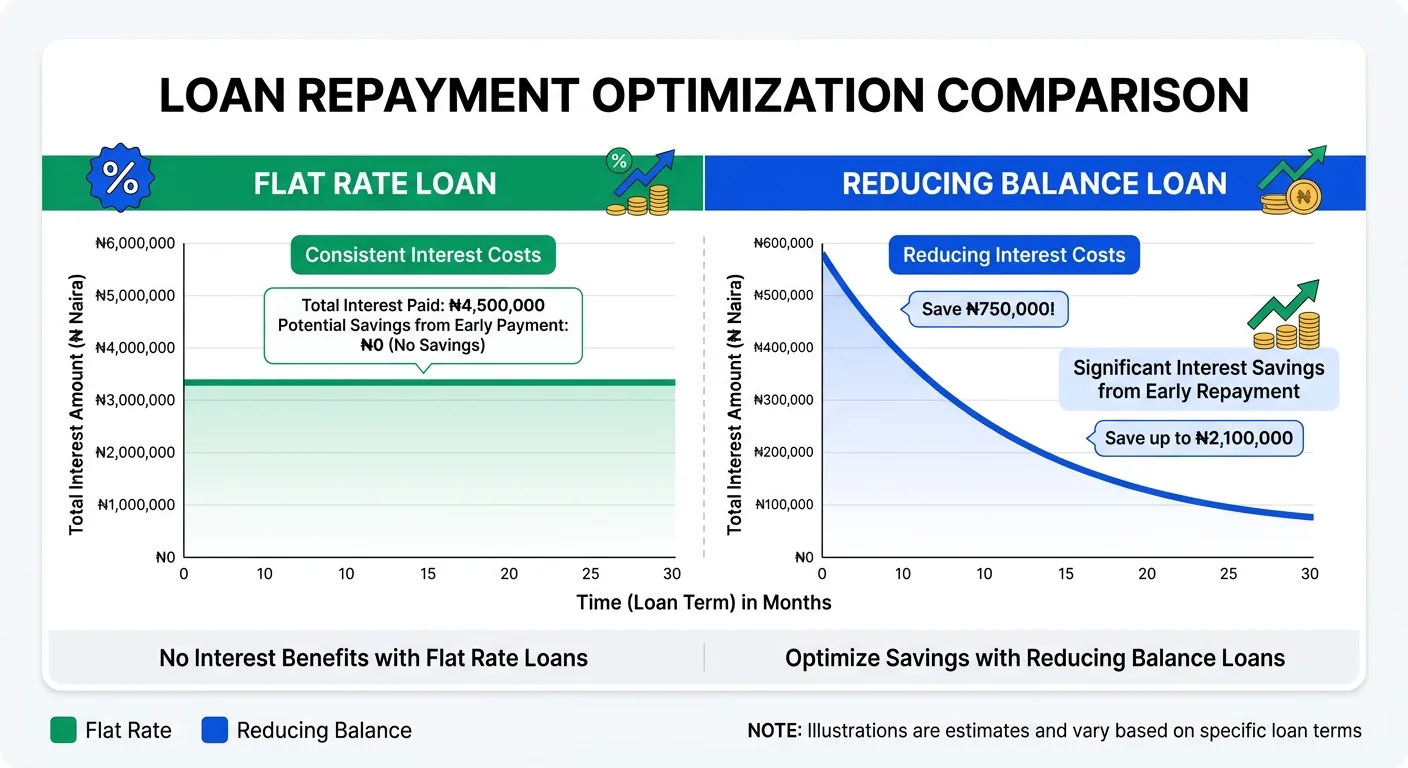
Early loan repayment in Nigeria only saves you money if your lender charges interest the right way. Two models exist across the market:
Flat Rate Interest (Pre-Calculated)
Your interest is locked in on Day 1 and added to your repayment total immediately. Borrow ₦50,000 at 10% for 30 days — your repayment is fixed at ₦55,000 whether you pay on Day 3 or Day 30. The lender collected their profit the moment you accepted the offer.
Early loan repayment in Nigeria under this model saves you exactly ₦0 in interest.
Reducing Balance or Daily Accrual Model
Interest is calculated on your outstanding balance day by day. Pay ₦20,000 back on Day 5 and interest only accrues on the remaining ₦30,000. The faster you repay, the less interest accumulates overall.
With this model, early loan repayment in Nigeria is genuinely profitable for you as the borrower.
The uncomfortable truth: Most short-term Nigerian loan apps — including many of the most popular platforms — use the flat rate model. They pre-collect the full interest regardless of when you repay. Only some longer-tenor instalment lenders, like Renmoney and certain microfinance bank products, use the reducing balance structure.
Before you pay early, ask your lender directly: "Is my interest pre-calculated, or does it reduce if I pay ahead of schedule?" If they cannot answer clearly, check your loan agreement before touching that button.
Prepayment Penalties in Nigeria: Yes, Some Lenders Charge You Extra for Paying Early
This is real, it is legal, and it was buried in that long contract block you scrolled past when you were focused on receiving your money.
Lenders charge prepayment penalties because early repayment costs them future interest income. To protect that revenue, some build in an early settlement fee — also called a "breakage cost" or "prepayment charge."
In Nigeria, prepayment penalties appear most often in:
- Salary advance platforms tied to employer payroll deductions
- Cooperative or FMCG loan schemes with fixed tenors
- Some microfinance bank personal loans with 6–24 month terms
For mainstream consumer apps like FairMoney, Carbon, and Branch, formal prepayment penalties are less common — but "less common" is not the same as "absent." Always scan your contract for these phrases: "early repayment fee," "settlement charge," "prepayment penalty," or "breakage cost."
If a penalty exists, do the maths: is the penalty smaller than the interest you would save by paying early? If yes, proceed. If no — pay on your normal schedule and keep your money working elsewhere.
When Early Loan Repayment in Nigeria Actually Works in Your Favour
You Have a Reducing Balance Loan
This is the clearest case for early action. Every additional payment reduces the principal that continues generating daily interest. Even a ₦5,000 extra payment mid-cycle produces measurable savings by the end of the tenor.
You Are Building Your Credit Limit for Future Loans
Many Nigerian loan apps use repayment behaviour to increase credit limits and lower rates for returning borrowers. Even if early loan repayment in Nigeria saves you zero interest today, clearing your loan early signals reliability to the platform's scoring engine — unlocking larger, cheaper loans the next time you need them.
You Are Stuck in a Multi-Loan Spiral
If you are juggling three active loan apps simultaneously, clearing the smallest one early reduces your monthly debit pressure and frees up cash flow. This is the Debt Snowball approach — not mathematically optimal, but psychologically powerful. One fewer debit alert per month is genuine financial relief.
Your Money Is Available Now but Will Be Gone Next Week
Nigerian financial reality is unpredictable. If your salary entered but rent, school fees, and feeding will swallow it before your loan due date — paying the loan now protects you from a late fee or a default mark that damages your borrowing profile. Prevention is cheaper than penalty.
When You Should NOT Rush Into Early Loan Repayment in Nigeria
You Will Be Completely Broke Afterward
If paying early drops your account balance to ₦0 and you will need to borrow again within two weeks, you are not escaping debt — you are rotating inside it. The borrow-repay-borrow cycle is exactly how loan dependency deepens. Maintain at least a small buffer before making aggressive early payments.
Your Interest Is Already Flat Rate
If the lender pre-calculated your interest and there is no credit score benefit to paying early, there is no financial logic to rushing. That money serves you better as an emergency cushion, stocked groceries, or fuel for the week.
You Have Higher-Cost Debt Running Elsewhere
Clearing a 5%-per-month loan while a 25%-per-month loan continues running is poor priority management. Always attack your most expensive active debt first. This is the Debt Avalanche method — it saves the most money mathematically and is the smarter sequence for early loan repayment in Nigeria when multiple debts compete for the same cash.
The 3-Question Test: Run This Before Any Early Repayment Decision
This framework applies to every early loan repayment situation in Nigeria:
Question 1: Is my interest flat rate or reducing balance?
If flat rate — there are no interest savings from paying early. Only proceed if a separate benefit exists such as avoiding late fees or boosting your credit profile.
Question 2: Is there a prepayment penalty in my contract?
If yes — calculate whether your projected savings exceed the penalty cost. If the penalty wins, wait for your scheduled due date.
Question 3: Will I be broke immediately after paying early?
If yes — you will borrow again soon, cancelling out any benefit. Hold the money and pay on the normal date instead.
If you clear all three questions and early repayment still makes sense — move sharp-sharp and get it done.
How to Pay Off Nigerian Loans Faster When It Is Actually Worth It
Round up every payment. If your instalment is ₦12,500, pay ₦13,500. On a reducing balance loan, those extra naira directly cut the principal that keeps generating interest charges.
Direct windfall money at your highest-interest debt. 13th-month salary, year-end bonus, side hustle income — before it disappears into daily expenses, move a portion directly to your most expensive active loan. Even one extra ₦10,000 payment can shave weeks off a 6-month repayment schedule.
Automate repayment within 24 hours of salary entry. Most Nigerian borrowers miss payments not because they lack money, but because the money disappears before the debit date arrives. Schedule your loan repayment to process the morning after your salary lands. What your eyes do not see, your fingers cannot spend.
Negotiate restructuring before you miss a payment — never after. If you genuinely cannot meet your repayment, contact your lender before the due date. Several Nigerian lenders will extend your tenor or reduce your monthly instalment if you approach them proactively. Silence remains the most expensive choice any borrower can make.
The Real Goal of Early Loan Repayment in Nigeria
Early loan repayment in Nigeria is not automatically the smart move. It depends on your interest structure, whether penalties apply, and whether paying now leaves you financially stable or immediately forces you back to a loan app screen.
The borrowers who consistently come out ahead are not the ones who pay the fastest. They are the ones who understand their loan terms, run the three-question test, and make decisions based on actual numbers — not just the feeling of wanting to be free from debt.
Check your contract. Identify your interest model. Then decide — and when early repayment genuinely serves you, execute it without hesitation.
Because in Nigeria's lending environment, the borrower who reads before clicking is always the one who wins.
Frequently Asked Questions
Does paying FairMoney or Carbon loan early reduce the interest I owe?
It depends on your loan's interest model. Most short-term Nigerian loan apps use a flat rate structure where interest is pre-calculated on Day 1 and baked into your total repayment. Under this model, early loan repayment in Nigeria saves you no interest — you pay the same amount whether you repay on Day 3 or Day 30. Only reducing balance or daily accrual loans reward early repayment with genuine interest savings. Always confirm which model applies to your loan before rushing to pay.
Can a Nigerian lender legally charge me a penalty for paying my loan early?
Yes. Prepayment penalties are legal in Nigeria and must be disclosed in your loan agreement under CBN consumer protection guidelines. They appear in salary advance platforms, some microfinance bank products, and certain cooperative loan schemes. For mainstream apps like Branch or Carbon, formal penalties are less common but not impossible. Always scan your contract for the phrases "early repayment fee," "settlement charge," or "breakage cost" before making any early payment decision.
What is the smartest strategy for early loan repayment in Nigeria if I have multiple active loans?
If you have multiple loans running simultaneously, resist the urge to pay any single one early without a strategy. Use the Debt Avalanche method — target the highest-interest loan first to save the most money over time. If psychological relief matters more than pure maths, use the Debt Snowball method — clear the smallest loan first to reduce your monthly debit pressure and free up cash flow. Either way, maintain a minimum cash buffer before making aggressive early payments, or you risk needing to borrow again within weeks and undoing all your progress.
