

POSTED BY:
COMMENTS:
0
POST DATE:
Your landlord sends a message — "Oga, your rent is due next month." Your phone screen shatters the same week PHCN disconnects your estate. Your child falls sick and the hospital wants ₦30,000 deposit before they even look at the patient. Your car engine knocks on a Monday morning and your office does not do remote work.
For most Nigerians — civil servants, NYSC members, salary earners, students on allowances — these moments land like a slap from nowhere. Not because the emergency was unusual. But because there was absolutely nothing saved to handle it.
So what happens next? We borrow. We beg. We call that one aunty we have been avoiding. We download a loan app that charges 30% monthly interest and then spend three months in deeper sapa than before.
There is a better way. It is called an emergency fund Nigeria residents can actually build — and yes, you can start even when your salary is already crying.
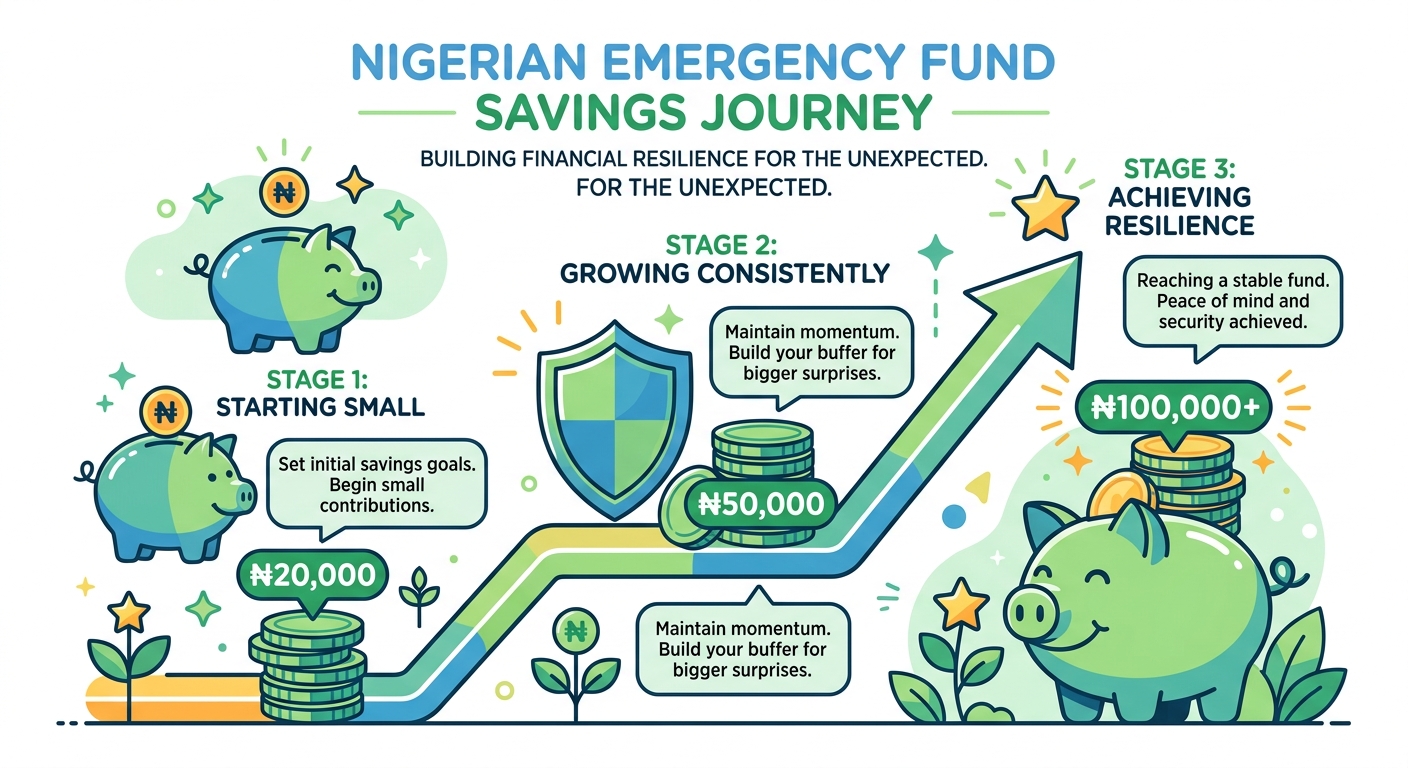
Do not let the bigger numbers intimidate you. Your first target when starting your emergency fund Nigeria journey is just ₦20,000. That one number alone will save you from taking a predatory loan the next time a small, unexpected expense arrives.
Build in stages:
- Stage 1: ₦20,000 — handles minor emergencies
- Stage 2: ₦50,000 — handles moderate financial shocks
- Stage 3: ₦100,000+ — gives you a true financial buffer
Celebrate each stage. Every milestone is real, measurable progress on your how to save money in Nigeria journey.
A genuine emergency has three features: unexpected, urgent, and unavoidable. If you could have planned for it, delayed it, or functioned without it — it is not an emergency. It belongs in a separate budget category, not your emergency fund Nigeria savings.
 Her system:
- Salary arrives on the 27th. On the 28th, ₦8,000 automatically transfers to her PiggyVest SafeLock — locked for 90 days at a time.
- She packs lunch to school four days a week, saving roughly ₦2,000 per week.
- She switched from large data bundles she never finished to a ₦1,500-per-week plan, saving ₦1,500 per month.
- She declined one asoebi invitation per quarter and redirected that money to her emergency fund Nigeria account instead.
The result after 12 months:
- ₦8,000 × 12 months = ₦96,000 in PiggyVest plus approximately ₦6,000 in earned interest
- ₦3,000 per month in additional casual savings = ₦36,000
- A ₦10,000 birthday gift she deposited instead of spending
- Total: ₦148,000 in emergency savings
She used ₦40,000 of it when her mother needed surgery. She cried — not from financial stress but from relief that she did not have to beg anyone, negotiate with a loan app, or call a relative who would never let her forget it.
She did not earn more. She redirected better. That is the entire strategy of building an emergency fund in Nigeria on a constrained income. According to research from EFInA (Enhancing Financial Innovation and Access), only 32% of Nigerian adults have any formal savings. Chioma is now part of that minority — and it is paying dividends in peace of mind.
Her system:
- Salary arrives on the 27th. On the 28th, ₦8,000 automatically transfers to her PiggyVest SafeLock — locked for 90 days at a time.
- She packs lunch to school four days a week, saving roughly ₦2,000 per week.
- She switched from large data bundles she never finished to a ₦1,500-per-week plan, saving ₦1,500 per month.
- She declined one asoebi invitation per quarter and redirected that money to her emergency fund Nigeria account instead.
The result after 12 months:
- ₦8,000 × 12 months = ₦96,000 in PiggyVest plus approximately ₦6,000 in earned interest
- ₦3,000 per month in additional casual savings = ₦36,000
- A ₦10,000 birthday gift she deposited instead of spending
- Total: ₦148,000 in emergency savings
She used ₦40,000 of it when her mother needed surgery. She cried — not from financial stress but from relief that she did not have to beg anyone, negotiate with a loan app, or call a relative who would never let her forget it.
She did not earn more. She redirected better. That is the entire strategy of building an emergency fund in Nigeria on a constrained income. According to research from EFInA (Enhancing Financial Innovation and Access), only 32% of Nigerian adults have any formal savings. Chioma is now part of that minority — and it is paying dividends in peace of mind.
Why Most Nigerians Lack Emergency Savings — And It Is Not Laziness
Let us be honest about something most financial advisors will not say out loud: building emergency savings Nigeria residents can sustain is genuinely hard. Not because Nigerians are careless with money. But because the environment is working against you at every angle. Here is the real picture:- Inflation is eating salaries alive. A ₦60,000 salary that felt workable in 2022 barely covers transport and food in 2025, with Nigeria's inflation rate hovering around 28–33% across food and energy categories per National Bureau of Statistics data.
- Family financial pressure is relentless. "You are working, you must have" is not a feeling — it is a phone call that comes every other week.
- There is no savings buffer culture. Most Nigerians grew up watching adults manage money from hand to mouth, so saving for "nothing yet" feels strange and even wasteful.
- Banks make saving unattractive. A standard savings account offering 4–6% annual interest while inflation runs at 30%? The math punishes you for trying.
- Irregular expenses keep arriving. WAEC fees, church levies, aso-ebi, generator fuel, school levies — Nigeria always has something new draining the wallet before the month ends.
How Much Should Your Emergency Fund Nigeria Target Actually Be?
The global recommendation is 3–6 months of living expenses. For the Nigerian context, here is a more practical breakdown:| Your Situation | Minimum Target |
|---|---|
| NYSC member or Student on allowance | ₦30,000 – ₦50,000 |
| Single salary earner (entry-level) | ₦50,000 – ₦100,000 |
| Civil servant with dependants | ₦100,000 – ₦200,000 |
| Mid-level earner (₦150k–₦300k/month) | 2–3 months of core expenses |
The ₦500-a-Day Method for Saving on Low Income in Nigeria
This is the most practical system for anyone dealing with financial stress Nigeria has created — especially those who believe they cannot afford to save: The Rule: Save ₦500 every single day. Not weekly. Not monthly. Daily. ₦500 × 30 days = ₦15,000 per month ₦500 × 90 days = ₦45,000 in 3 months ₦500 × 180 days = ₦90,000 in 6 months "But I do not have ₦500 free every day." Let us find it:- Skip one bottle of Coke and a roadside snack: ₦400–₦600 saved
- Walk one extra bus stop before boarding a danfo: ₦100–₦200 saved
- Cook at home two additional days per week: ₦500–₦1,000 saved
- Cancel one subscription you forgot was running: ₦300–₦800 saved
Where to Keep Your Emergency Fund Nigeria Account (Not Your Regular Bank)
This is critical. If your emergency fund sits in your regular transaction account, it will disappear. Life will "emergency" it away for non-emergencies within two weeks. Best options for storing your emergency savings Nigeria:PiggyVest SafeLock
Lock your money for a fixed period — you literally cannot withdraw without paying a penalty. This is discipline by design. PiggyVest's SafeLock offers 10–13% per annum, significantly better than a standard bank savings account and a smart home for your emergency fund Nigeria money.Kuda Bank Goals Feature
Set up a separate savings goal labeled "EMERGENCY ONLY." Kuda allows automatic saving from your balance and earns modest interest. It is free, fast, and designed specifically for Nigerians building emergency savings Nigeria on limited incomes.ALAT by Wema Bank
Nigeria's first fully digital bank offers a target savings feature built specifically for goal-based saving. Low minimum deposit, simple setup, and backed by a CBN-licensed commercial bank.A Second Bank Account at a Different Institution
Open a separate account at a bank you do not regularly use. No ATM card linked. No mobile app installed on your phone. The deliberate friction is the point — make it slightly inconvenient to access so you do not dip into your emergency fund casually for non-emergencies. Avoid: Keeping cash at home (theft, fire, "let me just use small") or mixing your emergency fund into your primary transaction account where it becomes invisible spending.The 4 Emergency Fund Killers Every Nigerian Must Avoid
These are the silent reasons most emergency savings Nigeria attempts collapse before they gain momentum: Killer 1 — "I will start next month" Next month has the same expenses as this month, plus new ones you have not seen yet. Start today with whatever you have. ₦200 today is a real start on your emergency fund Nigeria journey. Killer 2 — Borrowing from the fund for non-emergencies Your friend's wedding is not a financial emergency. A new phone is not an emergency. Asoebi for someone's party is definitely not an emergency. Protect your emergency fund like it belongs to someone else — because future-you is depending on it desperately. Killer 3 — Family pressure without a boundary plan Helping family is honourable and deeply Nigerian. But if every relative's situation drains your emergency savings Nigeria balance, you will always be one crisis away from financial collapse. A practical response: "I have something but I am currently managing something." That is not a lie. You are managing something — your financial survival. Killer 4 — Stopping after a withdrawal You used ₦40,000 from your fund for a hospital bill. That is exactly what the fund is for — well done. But many people never rebuild after a withdrawal. Restart contributions the very next salary payment, even at half your previous rate. Rebuilding is a core part of the emergency fund Nigeria system.What Counts as a Real Emergency vs. What Definitely Does Not
This distinction will protect your emergency savings Nigeria more than any other habit:| Real Emergency ✅ | NOT an Emergency ❌ |
|---|---|
| Hospital deposit or medical bill | Concert or event tickets |
| Job loss — urgent rent and feeding needs | Owning the newest phone model |
| Vehicle repair needed to get to work | Friend's birthday outing |
| Critical home repair (roof leak, flooding) | Asoebi or owambe contribution |
| Family member's urgent health crisis | A sale on something you want to buy |
| School fees deadline with late penalty | Sending a gift to impress someone |
Emergency Fund Nigeria vs. Taking a Loan — The Real Numbers
Straight answer: an emergency fund is always cheaper than a loan. The numbers prove it clearly. Scenario: You need ₦50,000 urgently. Option A — Your emergency fund exists: Cost = ₦0. You use your own money. You rebuild it over 2–3 months. No interest, no debt collector, no stress, no calls from loan app recovery agents. Option B — You take a loan app: ₦50,000 at 10% monthly interest = ₦55,000 due in 30 days. Roll it over for 3 months = you repay ₦65,000–₦70,000 for ₦50,000 borrowed. Net loss: ₦15,000–₦20,000 that flows to the lender instead of staying in your pocket. The loan is not always the villain — sometimes you genuinely have no other option in the short term. But building your emergency fund Nigeria base means you stop being a desperate, repeat loan customer and only borrow when it makes genuine strategic sense. People who default on loans most often do so not because they are irresponsible, but because they had zero buffer when the emergency hit. A savings cushion changes that equation entirely.Real Talk: How Chioma Built ₦145,000 in 12 Months on a ₦65,000 Salary
Chioma is a 26-year-old primary school teacher in Ibadan earning ₦65,000 monthly. She was tired of the financial stress Nigeria salary earners live with constantly. She committed to one year of disciplined emergency savings Nigeria — without earning a single extra naira.
Her system:
- Salary arrives on the 27th. On the 28th, ₦8,000 automatically transfers to her PiggyVest SafeLock — locked for 90 days at a time.
- She packs lunch to school four days a week, saving roughly ₦2,000 per week.
- She switched from large data bundles she never finished to a ₦1,500-per-week plan, saving ₦1,500 per month.
- She declined one asoebi invitation per quarter and redirected that money to her emergency fund Nigeria account instead.
The result after 12 months:
- ₦8,000 × 12 months = ₦96,000 in PiggyVest plus approximately ₦6,000 in earned interest
- ₦3,000 per month in additional casual savings = ₦36,000
- A ₦10,000 birthday gift she deposited instead of spending
- Total: ₦148,000 in emergency savings
She used ₦40,000 of it when her mother needed surgery. She cried — not from financial stress but from relief that she did not have to beg anyone, negotiate with a loan app, or call a relative who would never let her forget it.
She did not earn more. She redirected better. That is the entire strategy of building an emergency fund in Nigeria on a constrained income. According to research from EFInA (Enhancing Financial Innovation and Access), only 32% of Nigerian adults have any formal savings. Chioma is now part of that minority — and it is paying dividends in peace of mind.
Quick-Start Emergency Fund Nigeria Checklist
Use this to begin today — not after the next salary, not when things "settle down":- [ ] Calculate your monthly core expenses: rent, food, transport, bills only
- [ ] Set your Stage 1 target: ₦20,000
- [ ] Choose your savings vehicle: PiggyVest SafeLock, Kuda Goals, ALAT, or a separate bank account
- [ ] Decide your daily or monthly savings amount — even ₦200 per day counts toward your emergency fund Nigeria goal
- [ ] Set up an automatic transfer to trigger on payday before any discretionary spending
- [ ] Write down your personal emergency fund rules — what qualifies as a real emergency, what does not
- [ ] Tell only one trusted accountability person — keep it quiet from people likely to borrow from you
- [ ] Review your progress every 30 days and adjust contributions if needed
