

POSTED BY:
COMMENTS:
0
POST DATE:
Here is 3-Loan Trap. This article is an exit strategy. We will cover: Why your current repayment approach is probably costing you more money than you realise; Practical methods to repay loans faster in Nigeria — even on a modest salary; What to do when you genuinely cannot pay; A concrete 30-day debt exit plan you can start tonight.
Let's begin.
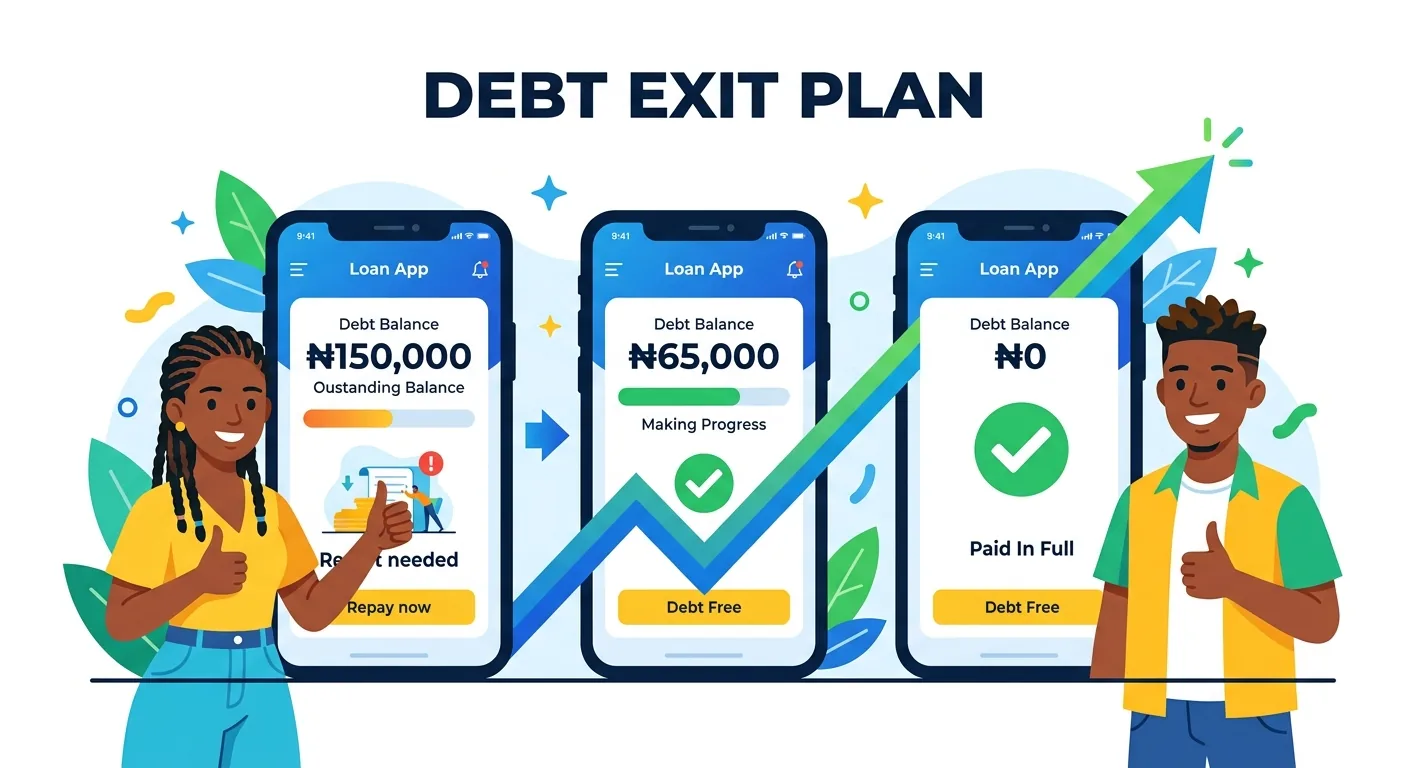
Once your debts are visible in one place, the panic reduces measurably. Chaos feels larger than the actual numbers. Clarity reveals that the problem, while serious, is finite and solvable.
Set phone reminders 5 days before each due date. Missing a due date on Nigerian loan apps triggers automatic late fees, credit bureau reporting, and recovery calls within 24–48 hours. Five days' advance notice gives you enough time to arrange funds, negotiate an extension, or make a partial payment that signals good faith.
Never borrow to repay unless the interest math clearly works in your favour. If you are taking a new loan at 10% monthly to repay a loan at 12% monthly, that is a calculated refinancing move — marginally acceptable. If you are borrowing at the same or a higher rate simply to delay the conversation, you are not solving debt. You are relocating it and making it more expensive. This is the single most common way Nigerians accidentally compound their loan burden.
For more structured guidance on managing debt obligations in the Nigerian context, Sharp Collect's resource library breaks down borrower responsibilities and collection rights in practical terms.

Why Nigerians Borrow Multiple Loans — And Why It Is Not Always Stupidity
Before strategy, let's be honest about reality. Many financial articles talk down to borrowers as if they took loans to buy designer shoes in Dubai. In Nigeria, the truth is sharply different. Here is why most everyday Nigerians end up with multiple loans: Salary delays. Federal and state government workers know this pain intimately. IPPIS glitches, subvention delays, and mysterious "salary reconciliation" exercises mean civil servants sometimes wait 6–8 weeks between payments. You still have to eat. The children still need school transport money. Thin income buffers. When your salary is ₦80,000–₦150,000 and you are managing rent, feeding, transport, utility bills, and family obligations, there is almost zero margin. One unexpected expense — burst tyre, sick child, damaged phone — and you are borrowing. Loan rollovers. Many Nigerian loan apps are architecturally designed to encourage rollovers. They make it friction-free to borrow again before you finish repaying the first loan. Before you realise it, you are in a cycle that feels impossible to break. The Sapa factor. Let's call it what it is — Sapa hits millions of Nigerians between the 20th and 31st of every month. And loan apps are right there, 24/7, no paperwork, no collateral, ready to offer "quick relief." That accessibility is both a feature and a trap. None of this is stupidity. It is the financial reality of millions of Nigerians operating in an economy with 30%+ inflation, stagnant wages, and structural gaps in the social safety net. Understanding how you arrived here is step one — because knowing how to manage loans in Nigeria effectively requires a clear, unsentimental picture of your starting point.The Real Cost of Slow Repayment — Interest Math Made Simple
Here is the section most borrowers skip — and it is the most expensive mistake they make. Let us say you borrow ₦50,000 from a loan app at 10% monthly interest. That is ₦5,000 per month in interest charges.- Repay in 2 months: Total interest = ₦10,000
- Repay in 4 months: Total interest = ₦20,000
- Roll it over twice with penalties: You might end up paying ₦30,000–₦35,000 in interest and fees alone
The Avalanche vs. Snowball Method — Which Works in Nigeria?
These are the two dominant debt repayment frameworks used globally. Let us translate them into Nigerian market reality.The Avalanche Method Explained
List all your loans from highest interest rate to lowest. Make minimum payments on all loans, but direct every extra naira toward the highest-interest loan first. Once that is cleared, move to the next highest, and repeat. Best for: Disciplined borrowers who want to pay the least total interest over time. Mathematically, the avalanche is superior — you surrender less money to lenders overall.The Snowball Method Explained
List all your loans from smallest balance to largest. Focus extra payments on the smallest loan first — regardless of interest rate — and use the psychological momentum of closing an account to fuel your attack on the next one. Best for: Borrowers who need motivation and quick wins to stay committed. Behavioural finance research consistently shows that the psychological satisfaction of eliminating a debt is a powerful and underrated repayment fuel.Practical Verdict for Nigerian Borrowers
If you have 3 loan apps running simultaneously, a rigid application of either method may not fit your reality. Here is the hybrid approach that works best for multiple loan repayment in Nigeria:- Start snowball first. Clear the smallest loan balance first. When that app's recovery officer stops calling, the emotional relief is real — and it sustains momentum for what comes next.
- Switch to avalanche second. Once you have breathing room and one fewer creditor, attack the loan with the highest daily or monthly interest rate. In most Nigerian loan apps, this is usually the one with the shortest tenor and the harshest rollover penalties.
How to Repay Loans Faster on a Fixed Salary
You cannot repay what you do not have — so let us talk about generating repayment capacity on a salary that is already stretched tight. Step 1: Perform a salary autopsy. The day your salary drops, before you spend a single kobo, write down every fixed obligation for the month: rent, feeding, transport, utilities, school fees, family contributions. What remains after those obligations is your debt war chest. Most Nigerians have never done this calculation on paper — doing it once is sobering, clarifying, and immediately actionable. Step 2: Create a dedicated repayment line. Treat your loan repayment exactly like a utility bill — non-negotiable and first priority. On salary day, immediately transfer your repayment allocation to a separate wallet or savings account. Opay, Kuda, PiggyVest Flex — pick whatever works. The goal is to physically separate those funds before they disappear into daily spending. Step 3: Find one deliberate sacrifice per month. You do not need to live like a monk. But identify one recurring expense to pause for the next 3–6 months: fewer streaming subscriptions, cooking at home more often, reducing weekend outings by one. An additional ₦5,000–₦8,000 in monthly repayment can save you ₦15,000–₦25,000 in cumulative interest over a single quarter. Step 4: Deploy windfalls immediately. Holiday bonus, side hustle income, a refund, an unexpected gift — the moment that credit alert arrives, direct at least 50% toward your loan. Do not think about it. Thinking time is spending time. Make the transfer before you make a plan. Step 5: Replace expensive debt with cheap debt. Many companies and government agencies run cooperative loan schemes or salary advance programs at 0–2% interest — far below the 8–15% monthly rates of most loan apps. If your employer or cooperative society offers this, use it to retire high-interest app debt immediately. You are not borrowing more money — you are refinancing at a fraction of the cost. This single move is one of the most underused debt repayment strategies available to Nigerian salary earners today.Managing Multiple Loans Without Losing Your Mind
If you currently carry 2 or more active loans, imposing structure is not optional — it is urgent. Chaos is expensive: missed due dates mean penalties, credit bureau entries, and recovery harassment. Build a Loan Register today. This is simply a written list — notebook, Google Sheets, or your phone notes app:| Loan App | Amount Borrowed | Balance Owed | Due Date | Monthly Interest Rate |
|---|---|---|---|---|
| FairMoney | ₦30,000 | ₦22,000 | Aug 15 | 8% |
| Branch | ₦20,000 | ₦20,000 | Aug 20 | 10% |
| PalmCredit | ₦15,000 | ₦8,000 | Aug 10 | 12% |
Warning Signs You Are About to Default — And How to React Fast
Loan default in Nigeria does not arrive suddenly. It builds across 4–8 weeks of small compromises and deliberate avoidances. Here are the specific warning signals: 🚩 You are using one loan to repay another every cycle. You are not clearing debt — you are shuffling it between apps while the total balance quietly grows. 🚩 Total loan repayments now exceed 40% of your monthly net income. Financial regulators globally recommend keeping debt service below 30–35% of take-home pay. Above 40%, you are structurally overextended. 🚩 You are avoiding opening your bank app or reading payment alerts. Emotional avoidance is not a coping mechanism — it is a default accelerant. Every day you avoid the numbers, penalties accumulate. 🚩 Your loan apps have begun reducing your approved credit limit. Their risk algorithms are detecting distress signals in your repayment behaviour before you consciously acknowledge them yourself. 🚩 You are borrowing for daily feeding and transport — not emergencies. When loans fund survival rather than unexpected costs, the debt structure has collapsed and requires urgent intervention, not additional borrowing. If three or more of these describe your current situation, you are in pre-default territory. The time to act is this week — not next month.What to Do If You Cannot Pay?
Most Nigerian borrowers do not know this: loan apps will negotiate with you. They are businesses with collection costs, legal constraints, and reputational incentives. They want repayment — not a drawn-out default that costs them more to recover than the original loan amount. Step 1: Contact them before they contact you. Call their support line or send an in-app message before the due date. Say clearly: "I have a salary delay this month. I cannot pay the full amount by [date], but I will pay [specific amount] by [specific future date]." Proactive communication is treated categorically differently from silence. Step 2: Request a formal restructure. Carbon (formerly Paylater) and FairMoney both have documented processes for restructuring repayment schedules when requested early. This does not always succeed, but it succeeds more often than borrowers assume — because the alternative, a full default that escalates to their legal or collections team, costs the lender real money. Step 3: Prioritise regulated lenders in your repayment sequence. If you must be late on one creditor, be late on the lender with the most professional recovery practices. Unregulated, unlicensed apps are statistically more likely to contact your family members, colleagues, and church community with harassment messages. Check the FCCPC's official list of approved digital lenders to verify which apps are properly licensed before you borrow from them. Step 4: Do not vanish. Silence is the most expensive response to a loan you cannot pay. When borrowers go quiet, apps escalate: recovery agents, contact harassment, negative credit bureau listings. A borrower who communicates — even just to say "I cannot pay yet but here is my specific timeline" — consistently receives better outcomes than one who ghosts. Step 5: Explore cooperative society emergency products. If you are a civil servant, teacher, healthcare worker, or employed by any large formal organisation, your cooperative society almost certainly offers an emergency loan product at 2–5% annual interest — specifically designed to help members escape high-interest external debt. This option is massively underutilised because people either do not know it exists or feel embarrassed to ask. Ask.
