

POSTED BY:
COMMENTS:
0
POST DATE:
Chidi was a civil servant in Enugu. Salary delayed, rent due, school fees calling. He downloaded a loan app someone mentioned in a WhatsApp group. The name looked professional. The interface was clean. He entered his BVN, uploaded his ID, gave the app access to his contacts and gallery — and collected ₦15,000.
Three weeks later, his contacts — his mother, his pastor, his office colleagues — started receiving WhatsApp messages containing edited photos of Chidi labeled "This man is a thief and a fraudster." His BVN had been used to attempt account access at two other banks. And the loan he borrowed at what appeared to be a small fee had quietly grown to ₦47,000 in charges he never agreed to.
Chidi's story is not unique. It is happening in Abuja, Lagos, Kano, Port Harcourt, and every city where workers are short on cash and long on urgency.
Illegal loan apps in Nigeria are not a fringe problem. They are a systematic, engineered financial trap — and this article is your protection manual. Read every section before you download anything.
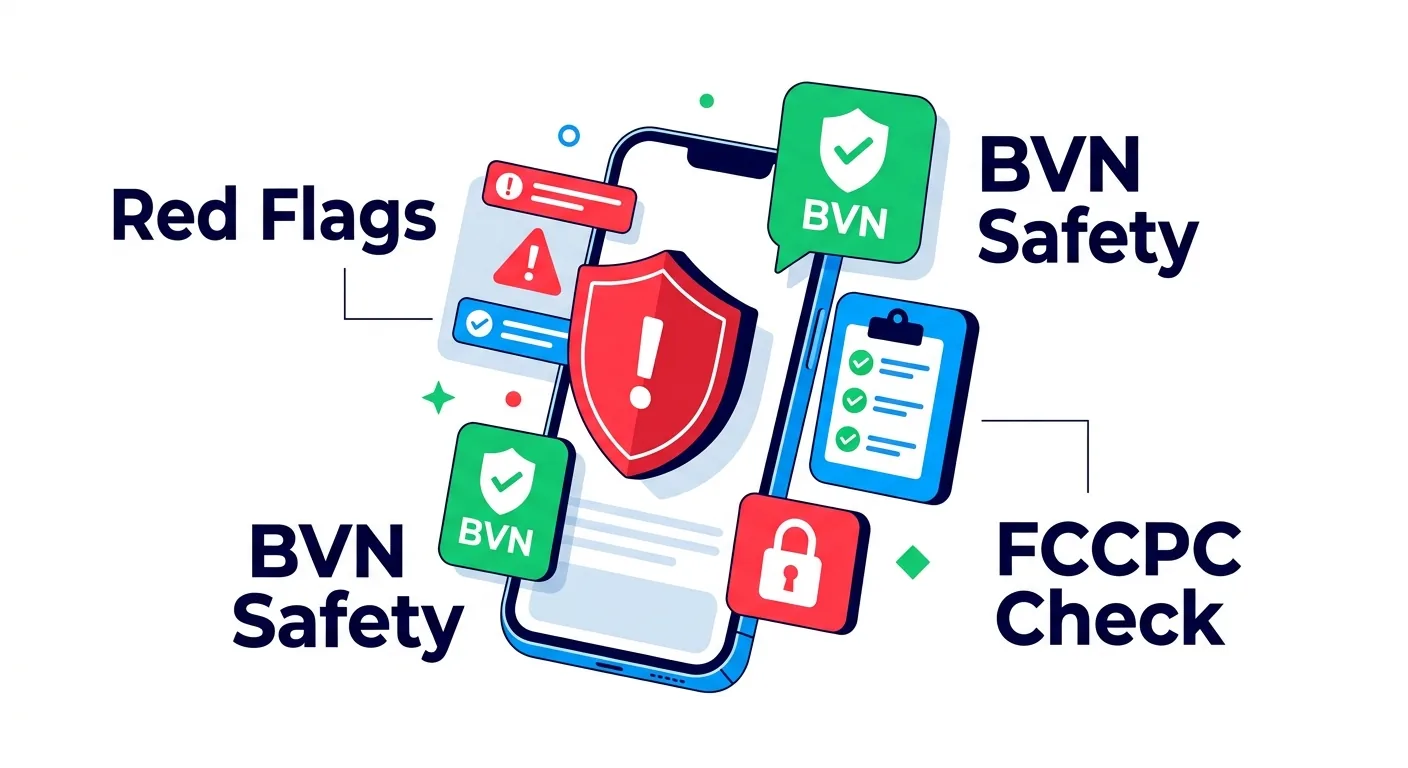
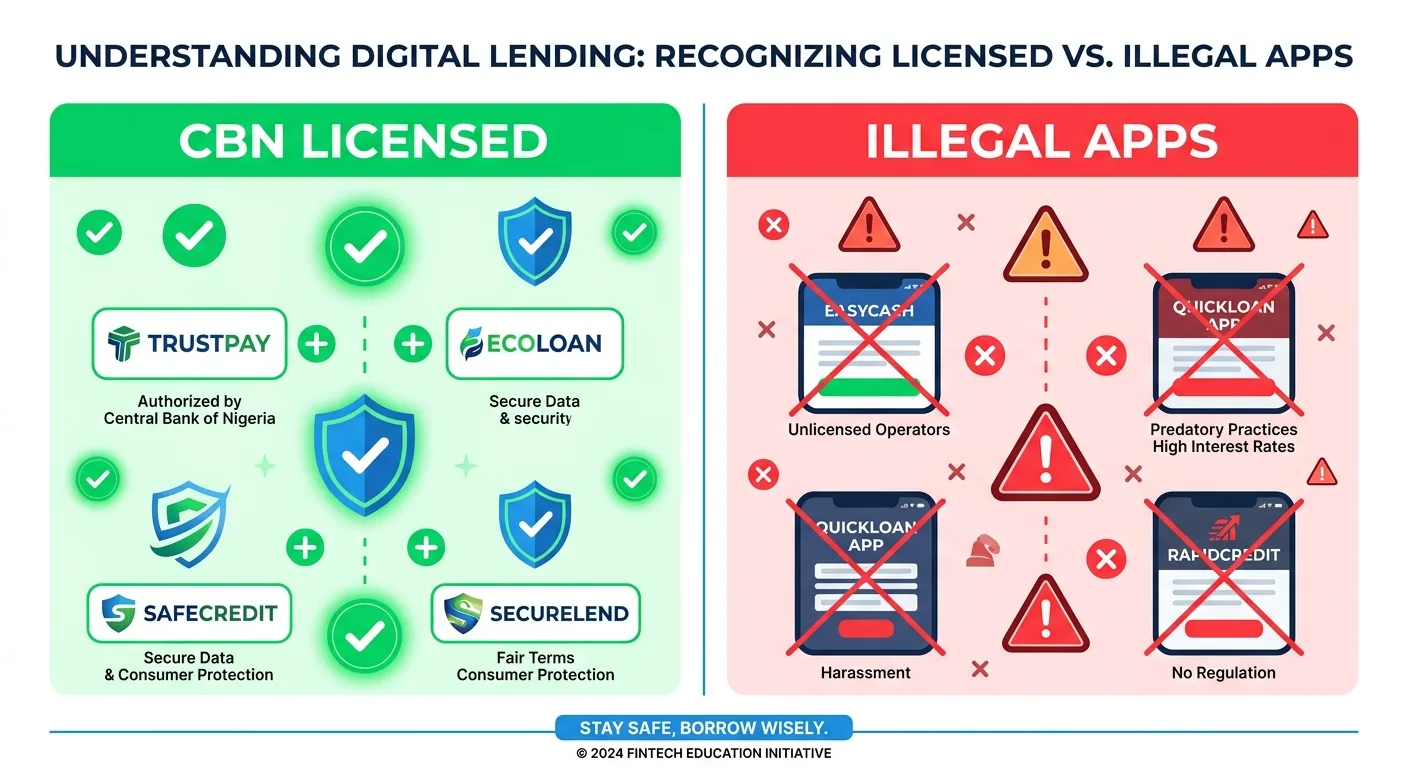
Sharp Collect is a legitimate loan app licensed by the FCCPC — no hidden BVN misuse, no contact list threats, no fees you never agreed to.
Why Illegal Loan Apps in Nigeria Are Winning Right Now
Sapa is real. Illegal lenders know it better than the CBN does. Nigeria has over 40 million financially underserved adults, according to EFInA's 2023 Access to Financial Services report. Banks reject most of them. Traditional microfinance institutions are slow, paperwork-heavy, and geographically limited. So when a loan app promises ₦10,000 in five minutes with no collateral, no guarantor, and no branch visit — people download it without asking a single question. Illegal loan apps in Nigeria exploit this desperation with precision. They invest in polished app design, fake five-star reviews on Google Play Store, and aggressive Instagram and TikTok advertising. They look licensed. They sound compliant. But they operate outside CBN regulation, outside FCCPC oversight, and outside any consumer protection framework that gives you enforceable rights. The Federal Competition and Consumer Protection Commission (FCCPC) and the CBN have both moved to shut these operators down — but new apps appear faster than enforcement can act. That is why you must be your own first line of defense.The FCCPC Blacklist — Your First Line of Defense Against Fake Loan Apps
The FCCPC is the Nigerian government agency responsible for protecting consumers from predatory businesses. Since 2022, they have been investigating, sanctioning, and publicly blacklisting illegal loan apps in Nigeria under their Limited Interim Regulatory/Registration Framework. Any digital lender operating in Nigeria is required to be registered with the FCCPC. Apps that appear on their blacklist have been confirmed guilty of one or more of the following:- Accessing borrowers' contacts without explicit, informed consent
- Harassing borrowers, family members, and colleagues via calls, SMS, and WhatsApp
- Charging undisclosed fees and interest rates that violate Nigerian consumer law
- Selling or misusing borrowers' personal and financial data
How to Find the FCCPC Blacklist Nigeria Database
Go directly to fccpc.gov.ng and navigate to their Digital Money Lenders section. The FCCPC periodically publishes both the approved operators list and the blacklisted ones. This is not a Twitter thread or a WhatsApp forward — it is an official government database with full legal standing. Most Nigerians have never visited that page. You now know it exists. Bookmark it today.7 Red Flags of Illegal Loan Apps in Nigeria — The Checklist
Screenshot this. Send it to your group chats. This is the difference between a loan and a trap.🚩 Red Flag #1: Full Contact Access Before You See Any Loan Terms
Legitimate apps may request limited permissions. But if an app demands access to every contact on your phone before it even shows you a loan offer — that permission is not a technical requirement. It is a weapon they intend to use against you later.🚩 Red Flag #2: No Verifiable Address, RC Number, or Customer Service Line
Search the company on the Corporate Affairs Commission portal at search.cac.gov.ng. If there is no RC number, no physical Lagos or Abuja address, and no working phone line beyond a WhatsApp number — the company does not exist in any legally accountable form.🚩 Red Flag #3: Loan Promises That Require Zero Verification
"Guaranteed ₦50,000 in 2 minutes. No BVN required." No CBN-compliant or FCCPC-registered lender in Nigeria can legally approve you without identity verification. Anyone advertising otherwise is collecting your data under false pretenses.🚩 Red Flag #4: Disbursement Far Below the Approved Amount
You applied for ₦20,000. You received ₦11,500 in your account. The difference vanished in "processing fees," "insurance premiums," and "admin charges" that appeared nowhere during your application. This deduction model is a documented practice of fake loan apps in Nigeria.🚩 Red Flag #5: Repayment Deadlines Under 7 Days
The FCCPC has published guidelines requiring reasonable repayment terms for digital lenders. Apps that lend ₦10,000 on Monday and demand ₦15,000 back by Saturday are structurally designed to trap you in a renewal cycle, not solve your cash flow problem.🚩 Red Flag #6: Harassment of Third Parties
The moment a loan app's recovery agent contacts your mother, your employer, your landlord, or your pastor — that app has committed a criminal offense under Nigerian law. This is not aggressive-but-technically-legal. This is a crime, full stop.🚩 Red Flag #7: Absent from Both the FCCPC and CBN Registers
If the app does not appear on the FCCPC approved digital lenders list and has no CBN-licensed parent entity — it is one of the illegal loan apps in Nigeria, regardless of how professional the branding looks.Loan App BVN Security: How They Steal Your Data and What Happens Next
Your BVN is the most sensitive financial identifier you hold in Nigeria. It links your legal identity to every bank account you own. When you hand it to an unregulated app, here is exactly what can happen: Account Profiling: Your BVN tells them your primary bank, your account age, and sometimes your approximate balance range. This data is used to calibrate how aggressively to pressure you during recovery. Identity Packaging and Sale: Your BVN, combined with your phone number, face photo, and national ID, creates a complete identity package. These packages are sold on dark web marketplaces. Other fraudsters buy them to open accounts, apply for loans in your name, or execute SIM swap attacks against your MTN or Airtel line. Loan Stacking Without Consent: Your data gets shared between affiliated illegal operators. Suddenly you have outstanding "loans" with apps you never downloaded — and your name circulates on WhatsApp debt-shaming lists. Unfair Credit Bureau Reporting: Some illegal loan apps in Nigeria, despite being unregistered, still push negative data to Nigerian credit bureaus like CRC Credit Bureau and FirstCentral. A loan you repaid gets marked as defaulted. Your credit profile suffers for an operator you should never have trusted. The non-negotiable rule: Give your BVN only to CBN-licensed institutions or FCCPC-registered digital lenders. That list is shorter than most people think — and that is precisely what makes it valuable.CBN Licensed Loan Apps vs. Unlicensed — The Structural Difference
The CBN does not issue specific "loan app licenses." It licenses the financial entities that operate them. Here is how the legal structure actually works in Nigeria:| Entity Type | Examples | Regulator |
|---|---|---|
| Commercial Banks with loan products | GTBank QuickCredit, Access Bank, UBA | CBN |
| Microfinance Banks | LAPO MFB, AB Microfinance, Accion | CBN |
| Finance Companies | Renmoney, some Carbon operations | CBN |
| FCCPC-Registered Digital Lenders | FairMoney, Branch, Palmcredit | FCCPC |
| Unlicensed Operators | Most apps in WhatsApp/Telegram groups | None |
Quick 3-Step Verification for CBN Licensed Loan Apps
- Visit cbn.gov.ng → Financial Institutions → check the licensed institutions database
- Visit fccpc.gov.ng → Digital Money Lenders → check the approved list
- Search the app name + "FCCPC approved" or "CBN licensed" on Google — verify that results lead to official government pages, not sponsored articles
The Shame-and-Threaten Playbook of Illegal Loan Apps in Nigeria
Understand their psychology so it stops working on you. Illegal loan apps in Nigeria built their entire recovery model on one behavioral insight: many Nigerians will pay any amount to avoid public humiliation. If they blast your WhatsApp contacts with edited photos calling you a fraudster, most people will pay — even fabricated, inflated "penalties" — just to make it stop. They count on your boss seeing it. They count on your family panicking. The loan disbursement is not the product. The shame mechanism is. This behavior constitutes a criminal offense under Section 24 of the Cybercrimes (Prohibition, Prevention, Etc.) Act 2015. It is also explicitly prohibited under the FCCPC's Digital Lending Code of Conduct. You have legal grounds to act. If it happens to you — do not pay out of fear. Document everything immediately. Screenshot every message. Save every number. Report formally to the FCCPC complaint portal and the Nigeria Police Force Cybercrime Unit. You are not powerless. The law is on your side.How to Verify Any Loan App Before You Download It — 5 Steps in 3 Minutes
Before you enter your BVN anywhere, run this checklist: Step 1: Google the app name + "Nigeria" + "FCCPC" — ignore social media results, look only for government or credible news sources Step 2: Check the Google Play Store developer name — legitimate companies use verifiable legal entity names, not generic tech names created last month Step 3: Read the 1-star reviews specifically — look for repeated patterns around hidden charges, contact list harvesting, and aggressive harassment Step 4: Search the FCCPC approved digital lenders list at fccpc.gov.ng directly Step 5: Look for a Terms and Conditions page that includes a real Nigerian company address, a CAC RC number, and a named customer service contact Complete all five steps and find nothing verifiable? Close the app store page. Walk away. The ₦15,000 is not worth the ₦47,000 nightmare that follows.What to Do If You Have Already Used an Illegal Loan App in Nigeria
First — breathe. You are not alone, and you still have options.Immediate Steps to Take Right Now
Change all your banking passwords and PINs today. Do not wait to see if anything goes wrong. Act preemptively. Call your bank's fraud desk. Tell them your BVN may have been exposed to an unregistered lender. GTBank, Access Bank, Zenith, and First Bank all have fraud monitoring units that can flag your account for heightened surveillance at no cost. File a formal report with the FCCPC. Visit fccpc.gov.ng or call 09-2707800. Bring the app name, screenshots of all communications, your transaction receipts, and the exact amount you received versus what was deducted. Do not pay invented penalties. If an illegal app is adding charges you never agreed to during your original application, you have no legal obligation to pay those fabricated fees. Pay only amounts explicitly stated in a written loan agreement — if one even exists. Control the narrative with your contacts. If the app has your contact list, send a proactive WhatsApp broadcast to key people in your life explaining what happened before the harassment begins. Remove their leverage before they use it.Sharp Collect is a legitimate loan app licensed by the FCCPC — no hidden BVN misuse, no contact list threats, no fees you never agreed to.
