

The amount they lend you is not the problem. The amount they charge when you're late — that's where the debt quietly doubles.
Nobody Puts the Penalty Page in the Advertisement
The loan approval takes five minutes. The money lands fast. The terms screen appears, you scroll quickly, you tap "agree" — and somewhere in that scroll is a clause that could cost you thousands of extra naira.
Not because you borrowed recklessly. Because your salary delayed. Because SUBEB didn't pay. Because the corper allowance was short by ten days. Because life happened — and the due date did not care.
That is exactly when loan app penalty fees Nigeria borrowers face kick into gear. And most people only discover what those fees look like when they are already inside them.
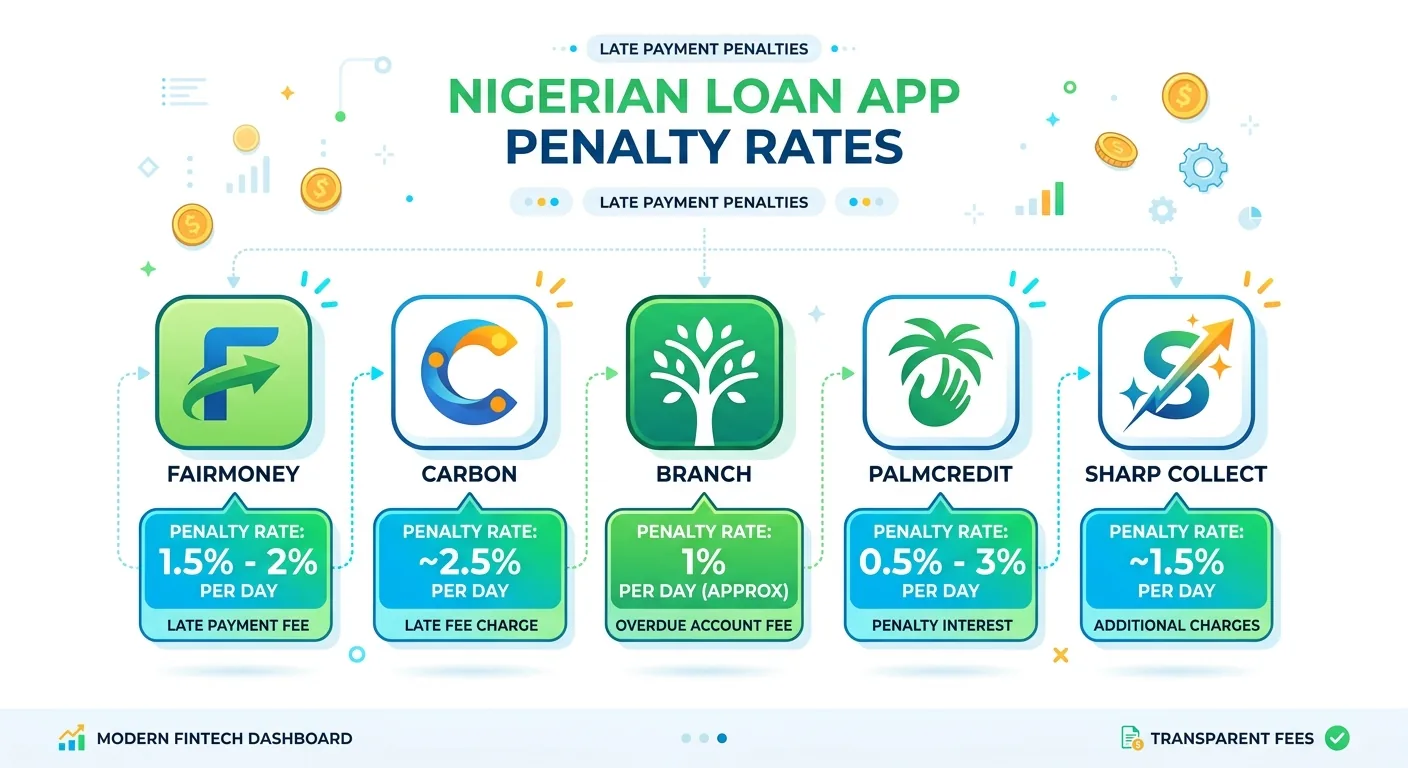
This article breaks down — in plain Naira terms — exactly what FairMoney, Carbon, Branch, Palmcredit, and Sharp Collect charge when repayment does not go as planned. No banking jargon. Just numbers.
What Is a Loan Penalty Fee?
A penalty fee — also called a late fee or default charge — is the extra amount a loan app adds to your outstanding balance when you miss your repayment date.
Simple example: You borrowed ₦20,000 and agreed to repay ₦23,000 by the 15th. You do not pay on the 15th. On the 16th, the app adds a penalty — maybe ₦500, maybe 1% of what you owe. Every day you remain overdue, more is added.
This charge is separate from your original interest. It is not part of the loan cost you agreed to upfront. It is an additional layer — and it compounds fast.
Understanding loan app penalty fees Nigeria structures before you borrow is the single most underrated financial skill a Nigerian borrower can have in 2025.
What Is Loan Rollover? (And Why It Can Wreck You)
Loan rollover is when an app gives you the option to extend your loan duration — for a fee.
This sounds helpful. It is not always.
Here is what actually happens: The app charges a rollover fee — essentially a fresh round of interest on your outstanding balance. You are not paying off the loan. You are paying to keep it alive. Roll it over again next month? Another fee. Another interest cycle.
Your original ₦20,000 loan slowly becomes ₦35,000 in total repayment — and you never received a single extra kobo.
This is not illegal. But it is the most dangerous feature most borrowers activate without fully understanding the cost. When researching loan app penalty fees Nigeria options, rollover mechanics deserve as much attention as the headline interest rate.
FairMoney — Penalty and Rollover Structure
FairMoney is CBN-licensed as a microfinance bank and one of the most widely used platforms among Nigerians tracking loan app penalty fees Nigeria terms.
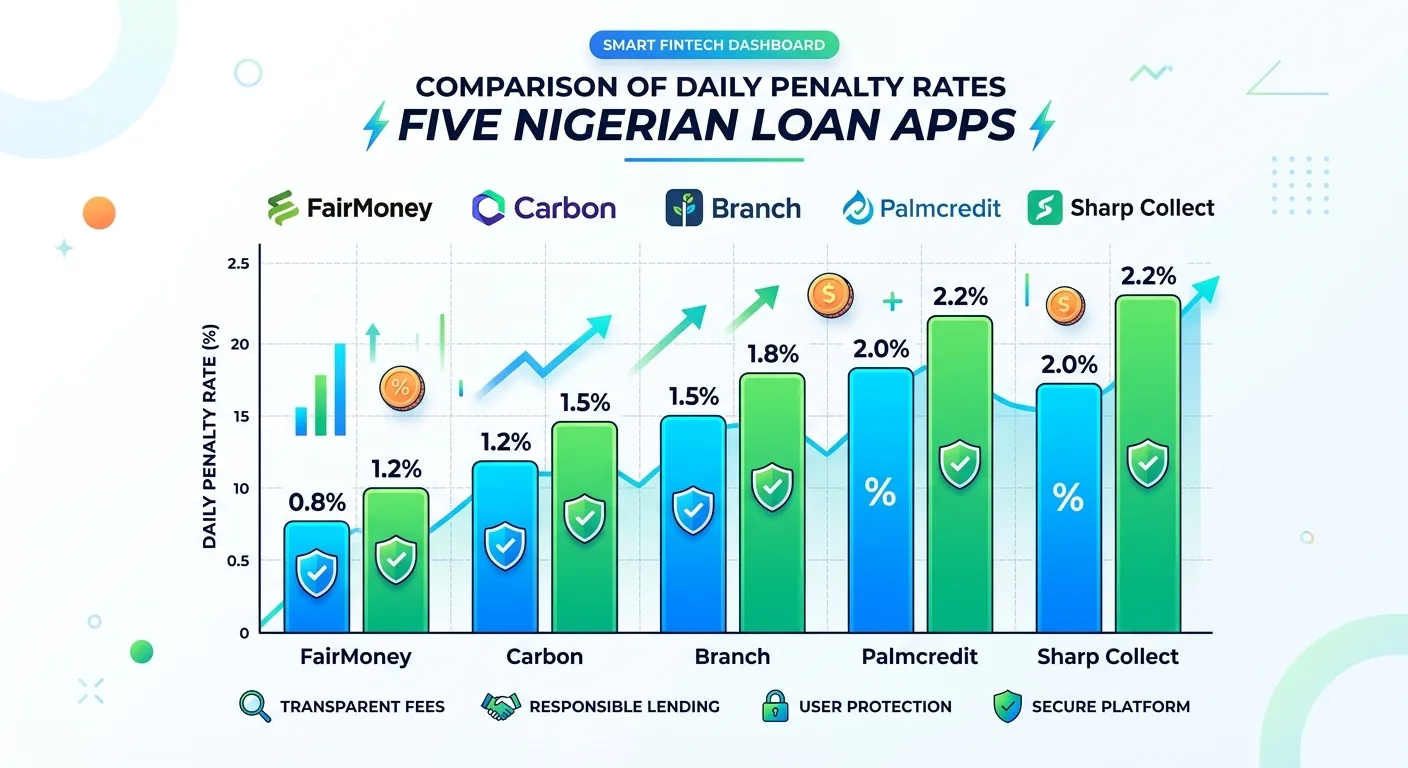
Daily Penalty Rate: Approximately 0.5% to 1% per day on unpaid balances, based on disclosed terms and documented borrower experiences.
On a ₦30,000 overdue loan: ₦150 to ₦300 per day. Thirty days late adds ₦4,500 to ₦9,000 on top of what you already owed — purely in penalties.
Rollover: Available in some cases, not all. When offered, it functions as a new interest charge on the outstanding balance.
Credit Bureau Reporting: Yes. FairMoney reports to the Credit Bureau. A default damages your borrowing profile across multiple platforms, not only FairMoney.
For salary earners: If your salary arrives unpredictably, do not take a FairMoney loan that runs to the very last day of the month. Build in a five-day minimum buffer.
Carbon — Penalty and Rollover Structure
Carbon (formerly Paylater) is a fully licensed digital bank. They are among the most transparent lenders in Nigeria — and also among the strictest when it comes to loan app penalty fees Nigeria enforcement.
Daily Penalty Rate: A flat 1% per day on overdue amounts. Clearly disclosed and consistently applied.
On a ₦25,000 overdue balance: ₦250 per day. Two weeks late adds ₦3,500. One full month late adds ₦7,500 — purely in penalties, on top of original interest.
Rollover: Carbon does not actively promote rollovers. They push for full repayment and escalate collection pressure quickly after due dates pass.
Credit Bureau Reporting: Aggressive. Carbon reports to CRC Credit Bureau and does not wait long. A Carbon default travels across Nigeria's entire credit ecosystem.
For salary earners: Carbon is excellent for disciplined borrowers. But their daily penalty rate is the highest in this comparison. Only borrow from Carbon when you are 100% certain repayment funds are arriving on a specific, confirmed date.
Branch — Penalty and Rollover Structure
Branch is an international fintech operating across Nigeria, Kenya, Tanzania, and India. They are known for growing loan limits as borrowers repay consistently.
Penalty Structure: Branch does not charge a traditional daily penalty fee. Instead, interest continues to accrue past the due date. Their annual rates range from 17% to 40% depending on tenure — but extended overdue periods still produce meaningful cost through continued accrual.
Branch will also freeze account access and escalate to debt recovery for significantly overdue accounts.
Rollover: Branch frames extensions as "refinancing" — you take a new loan to close the old one. It sounds clean. It restarts the interest cycle.
For salary earners: Branch is gentler on explicit daily penalties. The risk lies in long overdue periods where interest accumulation quietly inflates total repayment. Their model strongly rewards consistent repayers.
Palmcredit — Penalty and Rollover Structure
Palmcredit (operated by Newedge Finance Limited) targets first-time digital loan users with loans starting from ₦2,000. When comparing loan app penalty fees Nigeria options for small amounts, Palmcredit appears frequently.
Daily Penalty Rate: Approximately 0.5% to 1% per day on outstanding amounts, based on borrower-reported data. Loan amounts are smaller here, so absolute Naira penalties are lower — but the percentage impact remains serious.
Contact Harassment Risk: Palmcredit has faced documented complaints about reaching out to contacts saved on defaulting borrowers' phones. The FCCPC has issued guidelines against this practice. This is not a financial penalty, but it is a real and stressful consequence that shapes the full cost of defaulting here.
Rollover: Palmcredit sometimes offers a "top-up" — borrow more to offset what you owe. This is not a true rollover. It achieves the same result: more debt, more interest, a longer repayment cycle.
For salary earners and corpers: Repay Palmcredit on time or a few days early. The combination of daily penalties and aggressive collection practices makes being late here particularly stressful.
Side-by-Side Penalty Comparison Table
| App | Daily Penalty Rate | Rollover Option | Credit Reporting | Key Risk |
|---|---|---|---|---|
| FairMoney | ~0.5%–1% per day | Sometimes available | Yes (CBN MFB) | Fast fee accumulation |
| Carbon | ~1% per day | Rarely | Yes — aggressive | Highest daily rate in group |
| Branch | Interest accrual continues | Refinancing model | Yes | Long overdue = large accrual |
| Palmcredit | ~0.5%–1% per day | Top-up model | Yes | Contact harassment risk |
How to Protect Yourself Before You Borrow
Every Nigerian borrower — salary earner, NYSC corper, civil servant, student — should complete these steps before clicking "apply" on any platform with loan app penalty fees Nigeria consequences.
① Read the penalty clause before you borrow, not after
Every app shows full loan terms before disbursement. Scroll to "late payment," "penalty," or "overdue charges." If the language is buried or unclear, that is a transparency red flag.
② Calculate your worst-case total
Ask yourself: if I pay this loan 14 days late, how much do I actually owe? The formula: daily penalty rate × days overdue × loan balance. If that number makes you uncomfortable, reduce what you borrow.
③ Never borrow at the edge of your repayment capacity
If your salary is ₦60,000 and bills consume ₦55,000, do not borrow ₦30,000 expecting to repay from this month's salary. Only borrow money you can repay from funds you already know are arriving on a confirmed date.
④ Avoid rollovers unless it is a genuine emergency
Rolling over a loan feels like relief. It is expensive delay. Every rollover adds cost and extends the period you remain in debt.
⑤ Repay early whenever possible
Carbon and FairMoney do not penalise early repayment. If money arrives before your due date, pay immediately. You save interest, improve your credit score, and qualify for higher future limits.
⑥ Contact the lender before you default
This is the step most Nigerians skip. If you know your salary is delayed, contact customer support before the due date passes. A proactive borrower is always treated more flexibly than one who disappears.
Borrow with Your Eyes Open
Every app in this comparison is a legitimate, regulated lender. They are not enemies. For the salary earner whose rent is due, the corper who needs transport money, the worker whose child needs school fees — these platforms are genuinely useful tools.
But loan app penalty fees Nigeria structures are real, they are disclosed in the fine print, and they are enforced without sympathy once the due date passes.
The difference between a useful loan and a debt spiral is almost never the original borrowing amount. It is what happens when repayment does not land on the agreed date — and whether the borrower understood those consequences before they tapped "apply."
Now you know what they charge. Borrow sharp. Repay sharper.
Frequently Asked Questions
Q: Which loan app has the highest penalty fee in Nigeria?
Based on publicly disclosed terms and documented borrower experiences, Carbon charges the highest daily penalty rate in this comparison at approximately 1% per day on overdue balances. On a ₦25,000 loan that is one full month overdue, that translates to ₦7,500 in penalties alone — on top of original interest.
Q: Can loan apps in Nigeria report you to the Credit Bureau for late payment?
Yes. FairMoney, Carbon, Branch, Palmcredit, and Sharp Collect all report to Nigerian credit bureaus. A late repayment or default does not stay within the single app — it follows your credit profile and can affect your eligibility for loans across other platforms, including banks and cooperative lenders.
Q: What should I do if I cannot repay my loan app on the due date?
Contact the lender's customer support before the due date passes — not after. Many regulated lenders will discuss options with proactive borrowers. Avoid simply ignoring the debt, as penalties will continue to accrue daily and the account may be escalated to debt recovery. If you are being harassed by a lender, you can file a complaint with the FCCPC at fccpc.gov.ng.
