

What if the app you trust with your savings is quietly losing you money — not through fraud, but through a lower interest rate you never bothered to compare? Nigerians have real choices: Kuda, OPay, PiggyVest. But choosing the wrong one for your situation could mean earning half the interest you deserve. This breakdown settles it.
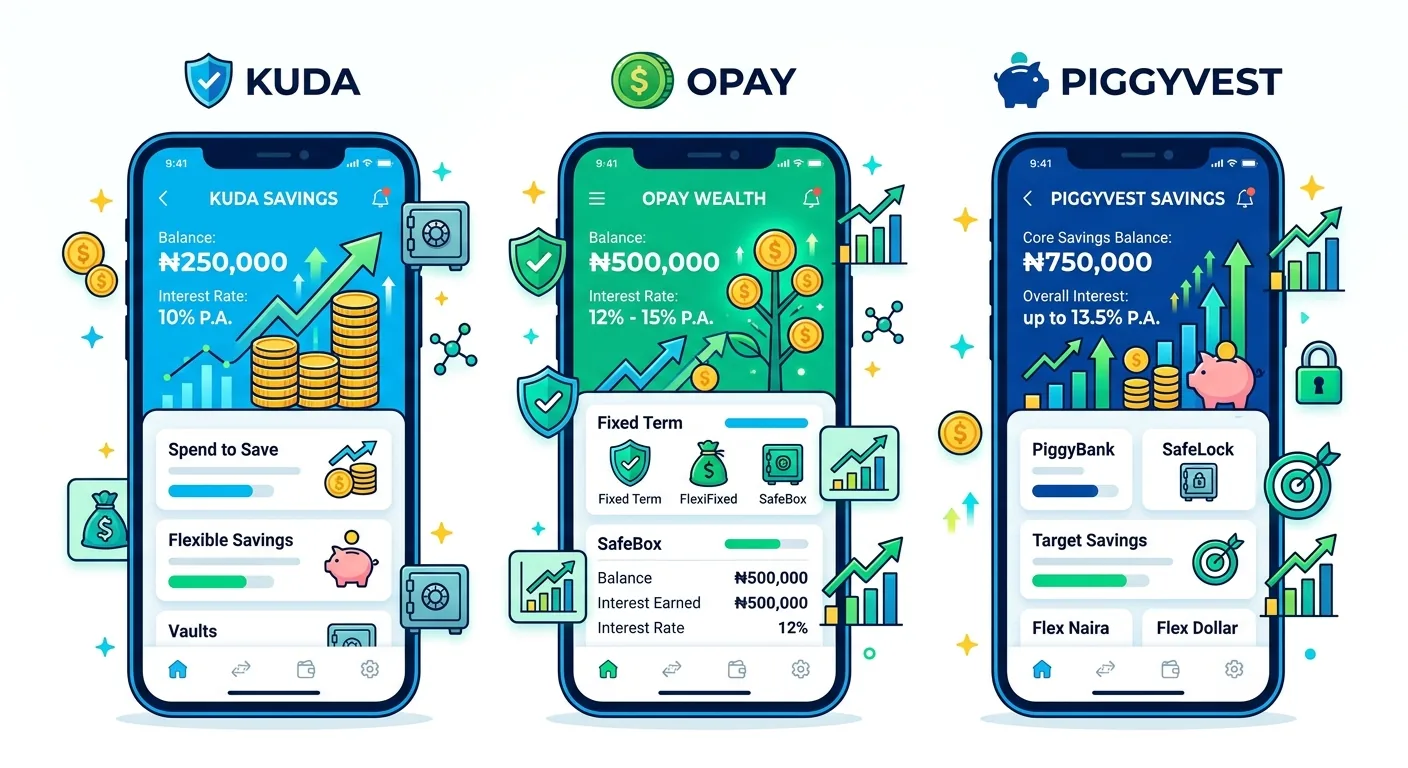
The Kuda vs OPay Savings Account Nigeria Debate Is Real — Here Is Why It Matters
Most Nigerians still keep money in traditional banks — GTBank, Access, First Bank — and receive virtually zero interest. Save ₦50,000 for six months and the bank gives you ₦87. Eighty-seven naira. Meanwhile, inflation runs at double digits and your purchasing power quietly dies.
Digital banks arrived — Kuda, OPay, PiggyVest — and suddenly everybody is excited. But here is what most Nigerians do not realise: not all digital savings accounts are built the same. The interest rates differ. The withdrawal rules differ. The hidden charges differ.
For a salary earner, civil servant, or NYSC corper squeezing savings from an already-thin income, the wrong platform could mean losing money to fees instead of gaining it through interest. The Kuda vs OPay savings account Nigeria comparison is not just academic — it is the difference between your ₦20,000 growing and it quietly shrinking.
Quick Snapshot: Kuda vs OPay vs PiggyVest at a Glance
| Feature | Kuda Bank | OPay | PiggyVest |
|---|---|---|---|
| Savings Interest Rate | ~10–15% p.a. | ~15–18% p.a. | Up to 10–13% p.a. |
| Instant Withdrawal | Yes | Yes | No — locked savings |
| Automated Savings | Spend+Save | AutoSave | Multiple goal types |
| CBN Licensed | Microfinance Bank | Payment Service Bank | Via partner banks |
| Hidden Fees | Low after free limit | Very Low | Early withdrawal penalty |
| Best For | Daily banking + passive savings | High interest + easy access | Disciplined goal-based saving |
Rates are subject to change. Always confirm current figures on each official app.
Interest Rates — Who Is Actually Paying You More?
This is the number that matters most when you are trying to grow ₦10,000 into something meaningful. In any serious Kuda vs OPay savings account Nigeria comparison, the interest rate gap is real and worth understanding.
Kuda Bank offers interest through its Spend+Save tool, hovering around 10–15% per annum depending on which savings product you activate. For a salary earner setting aside ₦20,000 monthly, this compounds into something respectable over time.
OPay's Save feature is the most aggressive right now — offering rates between 15–18% per annum on its AutoSave product. If you earn ₦80,000 monthly as a civil servant and save ₦15,000 monthly with OPay, the interest becomes visibly meaningful within 60–90 days.
PiggyVest sits at 10–13% per annum on its PiggyBank feature. Their Safelock product — where money is locked for a fixed period — can edge slightly higher. But you cannot touch locked money without paying a penalty.
Verdict on interest: If maximum interest on flexible savings is your only goal, OPay Save is currently winning this round of the Kuda vs OPay savings account Nigeria comparison. But interest rate alone does not tell the full story.
Ease of Access — How Fast Can You Withdraw When Sapa Hits?
Nigeria is not a country where you can always plan perfectly. Medical emergencies happen. Rent becomes suddenly due. The NEPA bill arrives triple the normal amount.
Kuda wins on accessibility. Because it is a full digital bank — not just a savings app — your money is available instantly, even at midnight. No waiting period, no wahala.
OPay is equally fast. The OPay wallet is built for speed: same-day access, instant transfers, no drama. AutoSave funds are accessible, though you should confirm minimum holding periods on specific products directly in-app.
PiggyVest is the strictest. PiggyBank savings are only withdrawable on dates you set at signup — monthly or quarterly. Break early and you forfeit some interest. The Safelock product is completely frozen until your chosen end date.
The Sapa Test result: If you might need the money suddenly, Kuda or OPay is the safer choice in the Kuda vs OPay savings account Nigeria equation. PiggyVest is for people saving toward a specific goal they genuinely cannot afford to touch — school fees, December rent, JAMB registration.
Automated Savings — Which App Works Even When You Lack Willpower?
Most of us do not have the discipline to manually transfer savings every month. Automation is what separates people who actually save from people who only plan to save.
Kuda's Spend+Save automatically moves a fixed amount into savings whenever you spend or receive money. Set it once, forget it. Designed specifically for people who know they are bad at saving.
OPay's AutoSave lets you schedule daily, weekly, or monthly automatic deductions. For salary earners, set it to trigger the morning after payday — before you can spend on things you do not need.
PiggyVest's automated savings is the most flexible for goal-setting. Create multiple pockets — emergency fund, school fees, new phone, rent — each with its own automation schedule. This structure is powerful for low-income earners who want to mentally allocate money before spending it.
Winner: PiggyVest for structure. OPay for simplicity. Kuda for people who want savings baked into daily banking.

Safety and Regulation — Is Your Money Protected?
Never cut corners here, especially after watching some fintech platforms struggle in recent years.
Kuda Bank holds a CBN Microfinance Bank license and is covered by NDIC up to ₦5 million per depositor for microfinance banks.
OPay operates under a CBN Payment Service Bank license. PSB regulation differs slightly from full commercial banking, but OPay's scale and CBN supervision make it a credible institution for everyday savings.
PiggyVest is not a bank itself. It partners with licensed Nigerian banks — including FCMB — where your actual money is held. It is NDIC-insured through those partner banks.
Safety verdict: All three platforms in the Kuda vs OPay savings account Nigeria landscape are legitimate and regulated. Keep savings below the NDIC protection limit for maximum insurance coverage.
Hidden Fees That Quietly Swallow Your Interest
This is where many Nigerians receive painful surprises.
Kuda offers 25 free transfers monthly. After that, a small fee applies per transaction. If you are using Kuda heavily as both daily bank and savings tool, watch your transfer count carefully.
OPay has the lowest overall fee structure of the three. Transfers within OPay are free. Bank transfers attract small charges. Their savings product currently does not penalise withdrawals — verify current policy in-app since this can change.
PiggyVest's most important hidden cost is the early withdrawal penalty. Break a Safelock before the agreed date and you lose a portion of earned interest. This is intentional — the platform is designed to force discipline. In a genuine emergency, it will sting.
Fee verdict: For low-income earners watching every naira, OPay has the cleanest cost structure in the Kuda vs OPay savings account Nigeria comparison. PiggyVest's penalty is only painful if you break your savings commitment early.
Who Should Use Which App?
Use Kuda if:
- You want one app for both daily banking and passive savings
- You receive salary directly and want Spend+Save working automatically
- You are an NYSC corper who wants zero-fee banking with savings built in
Use OPay if:
- You want the highest interest rate on flexible savings right now
- You already use OPay for daily transactions and want savings in the same ecosystem
- You are a student or low-income earner who needs savings accessible in emergencies
Use PiggyVest if:
- You have a specific financial goal — save ₦150,000 for a laptop by December
- You want to lock money away from yourself so you stop spending it
- You are a civil servant building a six-month emergency fund
The Winning Strategy: How Smart Low-Income Earners Use Multiple Apps
Here is what financially sharp Nigerians are quietly doing in 2025 — and it goes beyond the basic Kuda vs OPay savings account Nigeria binary choice.
Step 1: Use Kuda as your primary account — receive salary, pay bills, activate Spend+Save for automatic daily micro-savings.
Step 2: On payday, move a fixed amount — even ₦5,000 — into OPay Save for higher interest on funds you might need within 3 months.
Step 3: Lock a non-negotiable amount in PiggyVest Safelock for a goal that is 6–12 months away. Touch it for nothing.
This three-layer approach gives you liquidity through Kuda, moderate returns with access through OPay, and high-discipline goal savings through PiggyVest — all running simultaneously. Financial planners globally recommend exactly this type of tiered savings structure, and Nigeria's digital banks now make it practical locally.
Final Verdict
Fresh NYSC corper earning ₦77,000 monthly: Start with OPay for its higher interest rate and easy access. Add PiggyVest after 2–3 months of consistency.
Civil servant earning ₦120,000 monthly: Kuda for everyday banking, PiggyVest for goal savings. Run both simultaneously.
The truth about the Kuda vs OPay savings account Nigeria question is this — the best savings app is the one you actually use consistently. A 15% interest rate on ₦0 saved is still ₦0. Start somewhere. Automate it. Watch it grow.
Nigeria's financial system is finally giving ordinary people tools that were once only available to the wealthy. The Kuda vs OPay savings account Nigeria decision has no single wrong answer — only the wrong application of the right tool for your specific situation.
Always verify current interest rates and terms directly on the official apps. Figures quoted reflect publicly available 2025 data and are subject to change by the platforms.
Frequently Asked Questions
Is OPay savings account safe for large amounts?
OPay operates under a CBN Payment Service Bank license, making it a regulated and credible platform. For amounts above the NDIC coverage threshold, consider spreading savings across multiple regulated platforms rather than concentrating everything in one app.
Can a Nigerian use Kuda and OPay savings accounts at the same time?
Absolutely — and many financially savvy Nigerians do exactly this. Use Kuda for daily banking with its Spend+Save automation, and OPay for higher-interest savings on funds you want accessible within 90 days. The two apps complement each other in the Kuda vs OPay savings account Nigeria strategy perfectly.
Which digital bank savings account is best for a Nigerian student?
For students, OPay offers the best combination of higher interest rates and quick access during emergencies. If you have strong financial discipline and a specific goal — such as saving for school fees — add a PiggyVest Safelock set to unlock two weeks before payment is due.
