

The Payday Reckoning Nobody Prepared You For
It is the 25th of the month. Salary just landed. Before you finish saying "God is faithful," your phone is already vibrating with four different notifications.
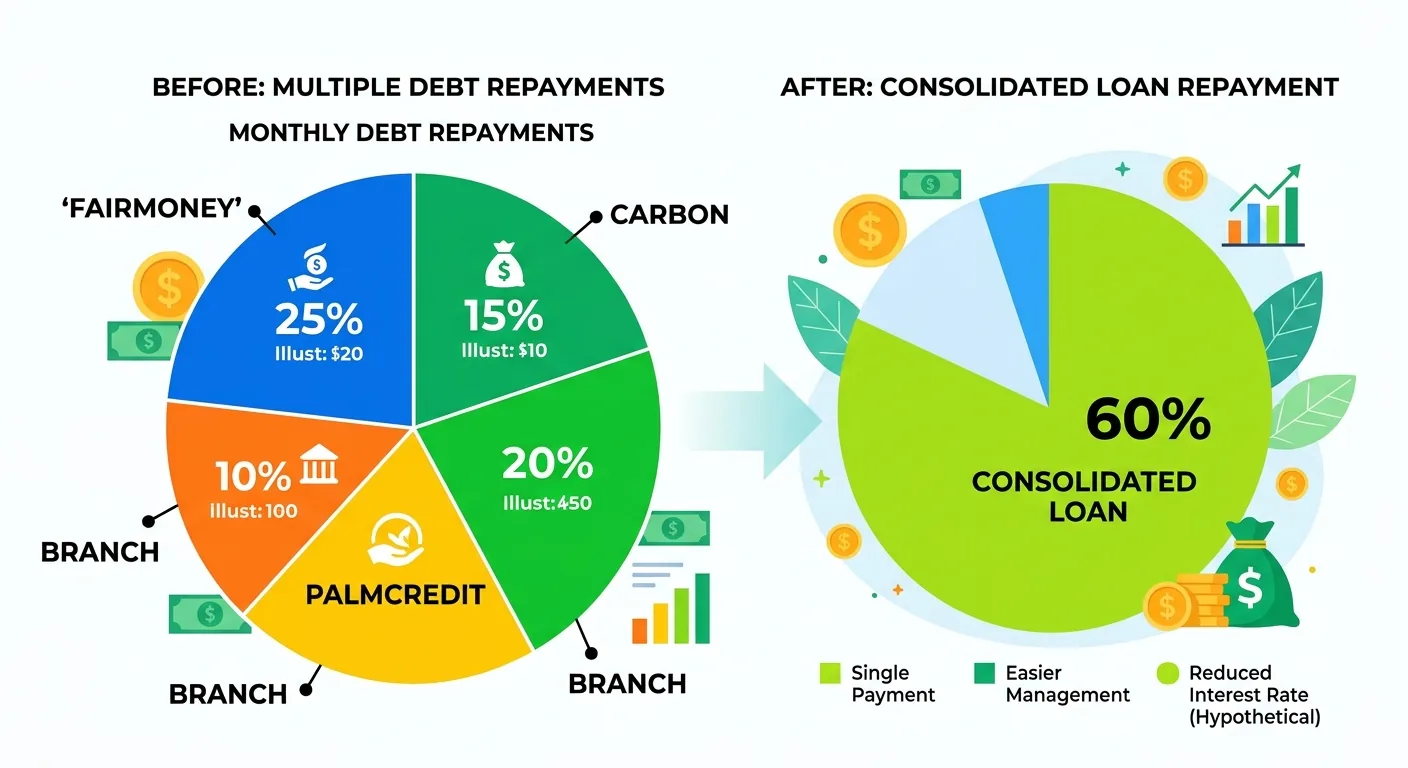
FairMoney wants ₦18,500. Carbon is deducting ₦12,000. Palmcredit sent a reminder for ₦9,200. And Branch will be sending theirs by morning.
By the time these four loan apps are done, half your salary is gone. Rent unpaid. Food budget untouched. You are already calculating which app will lend you survival money until next month.
This is not a budgeting failure. This is a debt stack problem. And the solution many salary earners are searching for — debt consolidation loans Nigeria — sounds simple in theory but requires serious eyes-open thinking before you move.
Let us break it down sharp-sharp.
What Debt Consolidation Means in Plain Nigerian English
Debt consolidation loans Nigeria simply means taking multiple loans you are repaying and merging them into one single loan — one monthly payment, one lender, ideally one lower interest rate.
Instead of paying FairMoney, Carbon, Branch, and Palmcredit separately every month, one lender gives you a bigger loan, pays off all four, and now you owe only that one lender.
In theory, this should:
- Reduce your total monthly repayment burden
- Lower your overall interest rate
- Simplify repayment into one predictable date
- Protect your credit standing across multiple platforms
In developed markets, this is a standard product. Banks offer it. Credit unions push it. Fintechs built entire businesses around it. In Nigeria? The situation is different — and you need to know exactly how different.
The Reality of Multi-Loan Living in Nigeria
A civil servant earning ₦85,000 monthly can qualify for a ₦20,000 loan on FairMoney, ₦15,000 on Carbon, and ₦10,000 on Palmcredit — all in the same week. The apps do not always see each other's records clearly, especially before BVN data propagates fully across Nigeria's credit bureaus.
So borrowers stack loans to survive emergencies: school fees, a medical bill, a broken-down okada. Before long, combined repayments are eating 40% to 60% of monthly income. That is not sustainable. That is sapa wearing a fintech jacket.
Does Formal Debt Consolidation Actually Exist in Nigeria?
Here is the honest truth most financial content avoids: dedicated debt consolidation loans Nigeria products are not widely available in 2025.
No lender's app has a "consolidate all my loans" button yet. What you do have:
- Salary advance platforms like Renmoney and Salary.ng offering larger, longer-tenor personal loans to salary earners
- Bank personal loans from GTBank, Access Bank, Zenith, and UBA that can serve a consolidation purpose if you qualify
- Cooperative society loans through your workplace, often at lower rates with longer repayment windows
- IPPIS-linked civil servant loans for federal government employees that can cover existing debts
None of these will close your loan apps for you. But a lump sum large enough to clear your high-interest app debts achieves the same result as formal debt consolidation loans Nigeria.
Options Nigerian Borrowers Can Use Right Now
Option 1: Renmoney Personal Loan
Renmoney offers personal loans up to ₦6 million for qualified salary earners with repayment periods up to 24 months. If your four apps collect ₦50,000 monthly and you replace that with a lower-rate Renmoney loan, you have effectively used debt consolidation loans Nigeria logic without a formal product.
What you need: Salary account, BVN, employment letter, recent payslips.
Option 2: Your Commercial Bank Personal Loan
GTBank QuickCredit, Access Bank's loan products, First Bank's FirstAdvance — these exist. Walk into a branch and ask specifically about personal loans for debt restructuring. Come prepared with your full debt list.
What you need: Six to twelve months of clean salary account history.
Option 3: Workplace Cooperative Society
The most underused tool in Nigeria. Many cooperatives charge 1% to 2% per month versus the 5% to 30% monthly effective rates on many loan apps. If your cooperative can give you a loan large enough to clear your app debts, take it immediately.
What you need: Active cooperative membership standing.
Option 4: The DIY Stack Attack
The version where you become your own consolidation officer — no formal lender required. Full breakdown in the step-by-step section below.
When Consolidation Makes Sense — And When It Does Not
It makes sense when:
- Combined monthly repayments exceed 35% of your net salary
- You have three or more active loans with different due dates causing constant anxiety
- At least one current loan carries interest above 15% per month
- A consolidation option offers a lower rate AND a longer repayment window
- You have the discipline not to borrow again from cleared apps immediately
It does NOT make sense when:
- The consolidation loan's effective rate is higher than what you currently pay
- You plan to reborrow from cleared apps the moment they reopen to you
- Your current debts clear within 60 days anyway
- Hidden fees completely cancel out the savings
The Hidden Costs Nobody Warns You About
This is where debt consolidation loans Nigeria trips most people up.
Processing Fees: Many personal loan products charge 1% to 3% upfront. On ₦200,000, that is ₦2,000 to ₦6,000 removed before you receive anything.
Longer Tenor Equals More Total Interest: Your monthly payment drops, yes. But stretching repayment from 3 months to 18 months may mean you pay far more in total interest. Always calculate the total repayment cost — never just the monthly installment.
Prepayment Penalties: Some lenders charge fees for early payoff. Ask before you sign.
The Cleared App Temptation: This is the number one way consolidation fails in practice. You clear FairMoney and Carbon. Two weeks later, you borrow from FairMoney again. Now you carry the consolidation loan plus a new app loan. You are worse off than before.
Step-by-Step: How to Consolidate Your Loans Yourself
If formal debt consolidation loans Nigeria products are out of reach, here is the DIY method:
Step 1: List every active loan — lender name, outstanding balance, monthly repayment, due date, and interest rate. Be brutally honest.
Step 2: Rank by interest rate, highest first. The loan costing you the most per naira gets attacked first — this is the avalanche method.
Step 3: Identify your cheapest available credit source. Cooperative? Bank? Salary advance? Find the lowest-cost option you actually qualify for today.
Step 4: Use that cheaper loan to kill your most expensive debt immediately. Do not spend any portion of it elsewhere.
Step 5: Channel the freed repayment into the next loan. Each loan you eliminate accelerates repayment of the next one — the debt avalanche snowball in action.
Step 6: Delete the apps you have cleared. Not pause. Not minimise. Delete. Remove your card and direct debit mandate. Make reborrowing genuinely inconvenient.
Warning Signs That Consolidation Will Make Things Worse
- You do not know exactly what you owe across all active lenders
- You have no stable income to service a larger consolidated loan
- You plan to use any portion of the consolidation loan for non-debt purposes
- The platform offering consolidation is unlicensed — verify via the CBN's licensed institutions directory before proceeding
- You have already defaulted on one or more loans being consolidated, which may disqualify you from formal products entirely
The Bottom Line — What Segun Would Tell His Cousin
If my cousin came to me today and said, "Segun, four loan apps are chewing my salary every single month," here is exactly what I would say.
First: Stop. No new loans until we map every naira owed — on paper, with pen.
Second: Find the cheapest money available — cooperative, salary advance, bank personal loan — not another loan app. Use that cheaper money to kill the most expensive debt first.
Third: As each app clears, delete it. Willpower alone is not enough. Remove access entirely.
Fourth: The real goal of pursuing debt consolidation loans Nigeria is not just to simplify your payment schedule. It is to reach a place where you owe one manageable debt with a clear end date, and payday no longer fills you with dread.
Debt consolidation in Nigeria is not a magic wand. No lender will rescue you at zero cost. But when done right — whether through a formal consolidation product or a disciplined DIY approach — it moves you from reactive borrowing to intentional repayment. And that shift is where financial freedom actually begins.
All information in this article is educational. Always verify lender licensing via the CBN or FCCPC directory before taking any loan.
Frequently Asked Questions
Q: Is there a loan app in Nigeria specifically for debt consolidation?
As of 2025, no Nigerian loan app offers a dedicated debt consolidation product. However, lenders like Renmoney, commercial banks, and workplace cooperatives can provide personal loans large enough to clear multiple app debts, effectively achieving debt consolidation loans Nigeria results without a formal program.
Q: Will consolidating my loans affect my credit score in Nigeria?
Consolidating through a reputable lender and closing high-interest accounts on time can improve your credit profile over time. However, applying for multiple consolidation loans in quick succession can trigger multiple bureau inquiries, which may temporarily lower your score. Apply to one qualified lender at a time.
Q: What is the biggest mistake Nigerians make with debt consolidation?
Reborrowing from cleared loan apps immediately after consolidation. The moment a cleared app reopens your credit limit, the temptation to borrow again undoes all the progress. Deleting the apps and removing saved card details is not optional — it is the most important step in any debt consolidation loans Nigeria strategy.
