

Emeka is a civil servant in Enugu. Salary is ₦87,000 a month. Clean work record. Never bounced a cheque. He walks into his bank, applies for a ₦150,000 personal loan to fix his generator and cover his daughter's school fees. The loan officer collects his documents and promises a callback.
Three days later: Declined. No explanation.
What Emeka did not know — what most Nigerians do not know — is that before the officer touched his documents, a system had already run a quiet check on his entire borrowing history. A ₦45,000 PalmCredit loan he half-paid eight months ago, plus a Buy Now Pay Later balance he ignored, had already delivered a verdict.
His credit score Nigeria lenders rely on had spoken before he opened his mouth.
This is the reality of borrowing in Nigeria today. The painful part? Most people do not even know their score exists, let alone what is in it.
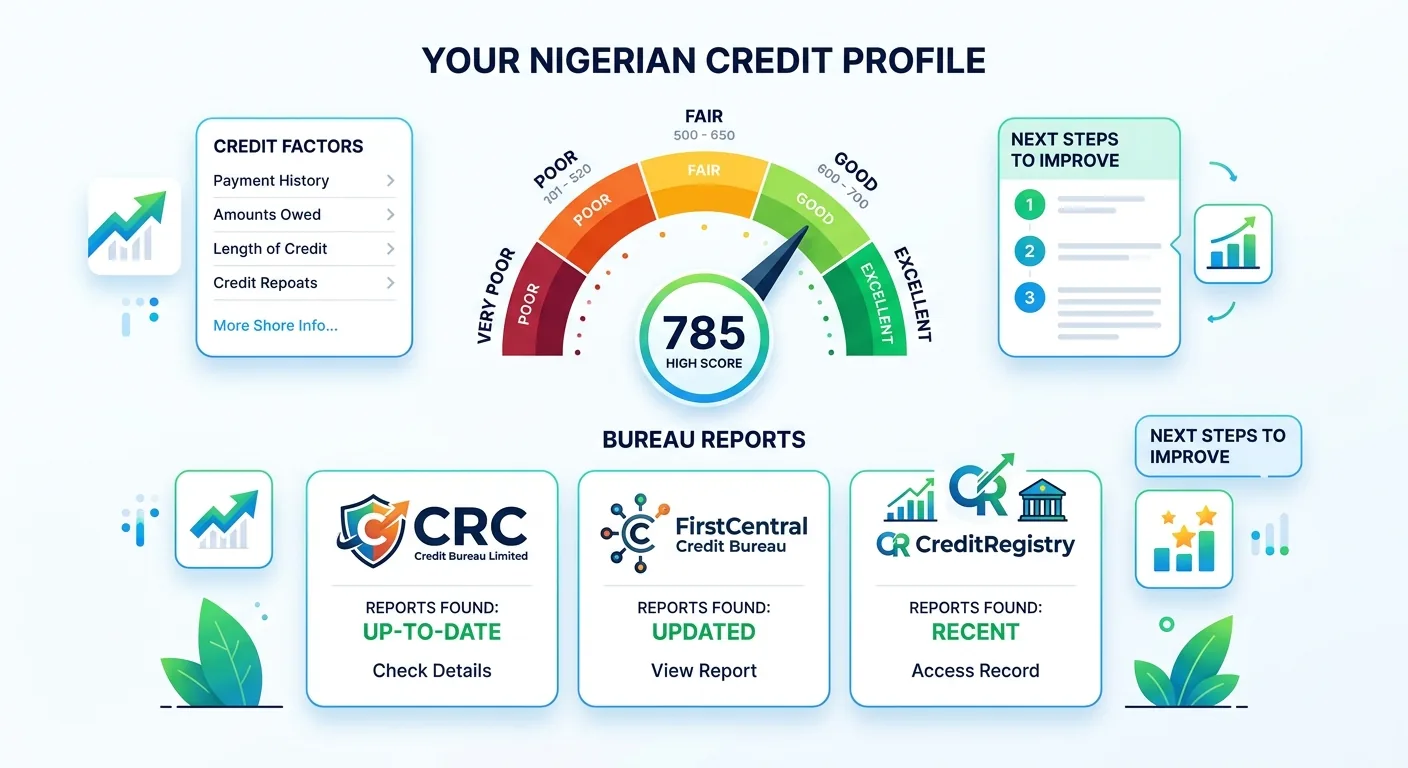
What Is a Credit Score Nigeria Lenders Actually Check?
A credit score is a numerical value — usually between 300 and 850 depending on the bureau — that represents how reliable you are as a borrower. The higher your number, the more confident lenders feel. The lower it is, the faster doors close.
Your credit score Nigeria lenders reference is not calculated by CBN directly. It is managed by licensed credit bureaus — private companies that collect your financial behaviour from banks, fintechs, mobile lenders, telecoms companies, and some utility providers.
Every time you borrow, repay late, default, or settle a debt, that data travels quietly to these bureaus. They store it. They score you. And they sell that report — legally — to any lender who pays to access it.
The CBN regulates this entire system under the Credit Reporting Act 2017. This is not a foreign concept being tested on Nigerians. It is official infrastructure that has been running quietly for years, and the number of lenders plugged into it grows every single month.
The Three Credit Bureaus Operating in Nigeria
There are three CBN-licensed credit bureaus operating in Nigeria right now. Knowing what each one does is non-negotiable if you want to protect your credit score Nigeria bureaus maintain on you.
CRC Credit Bureau
CRC is one of the oldest and most widely used bureaus in Nigeria. It collects data from commercial banks, mortgage institutions, microfinance banks, and several fintech lenders. If you have ever taken a loan from a traditional bank or registered microfinance institution, CRC almost certainly has a file on you.
FirstCentral Credit Bureau
FirstCentral partners with a broad network of lenders — including several loan apps and digital banks. They use a scoring model that grades borrowers from Poor to Excellent and provide detailed reports showing repayment history, current debts, and defaults.
CreditRegistry
CreditRegistry focuses heavily on the formal banking sector, with partnerships across several tier-one banks. Their data tends to reflect longer credit histories and uses international scoring models adapted for Nigeria.
Here is the critical point: different lenders check different bureaus. Your bank might check CRC. A fintech might check FirstCentral. Some lenders check two or all three. A negative record in one bureau follows you across multiple lender types — without you knowing it.
What Exactly Goes Into Your Nigerian Credit Score?
Your credit score Nigeria bureaus calculate is based on behaviour, not your account balance. These five factors carry the most weight:
1. Payment History — Did you repay previous loans on time? This single factor carries approximately 35% of total scoring weight. One default drops your number faster than anything else.
2. Amount Owed Versus Limit — If you are perpetually close to the maximum on multiple active loans, that signals financial stress to lenders — even if you are technically paying on time.
3. Length of Credit History — A borrower with three years of clean repayment history looks far more trustworthy than someone who appeared this month. Time builds trust in credit scoring.
4. Types of Credit Used — A mix of mobile loans, salary advances, and bank loans shows experience managing different debt types. Relying on a single source looks thin.
5. New Credit Applications — Every hard inquiry from a lender leaves a mark on your file. Apply to five different loan apps in one week and your score dips, even if nobody approved you.
How Loan Apps, Banks, and Fintechs Are Already Using Your Score
FairMoney, Carbon, Branch, PalmCredit — the loan apps on your phone — many are already plugged into at least one bureau. When you apply, they are not only checking your bank statement or BVN data. They are pinging the bureau for your full history.
For first-time borrowers with no credit file, some apps use alternative data — airtime top-up behaviour, mobile data usage, mobile money transactions — to predict your creditworthiness. This is called a thin file score. It can get you a small first loan, but it is not a substitute for a real credit score Nigeria bureaus have built from actual repayment records.
Traditional banks use bureau reports even more rigorously. The CBN has directed that any loan above a certain threshold must pass through bureau checks. For salary earners applying for cooperative loans, staff loans, or bank personal loans, your bureau score is not optional — it is a standard part of the process.
What a Bad Credit Score Nigeria Costs You in Real Naira
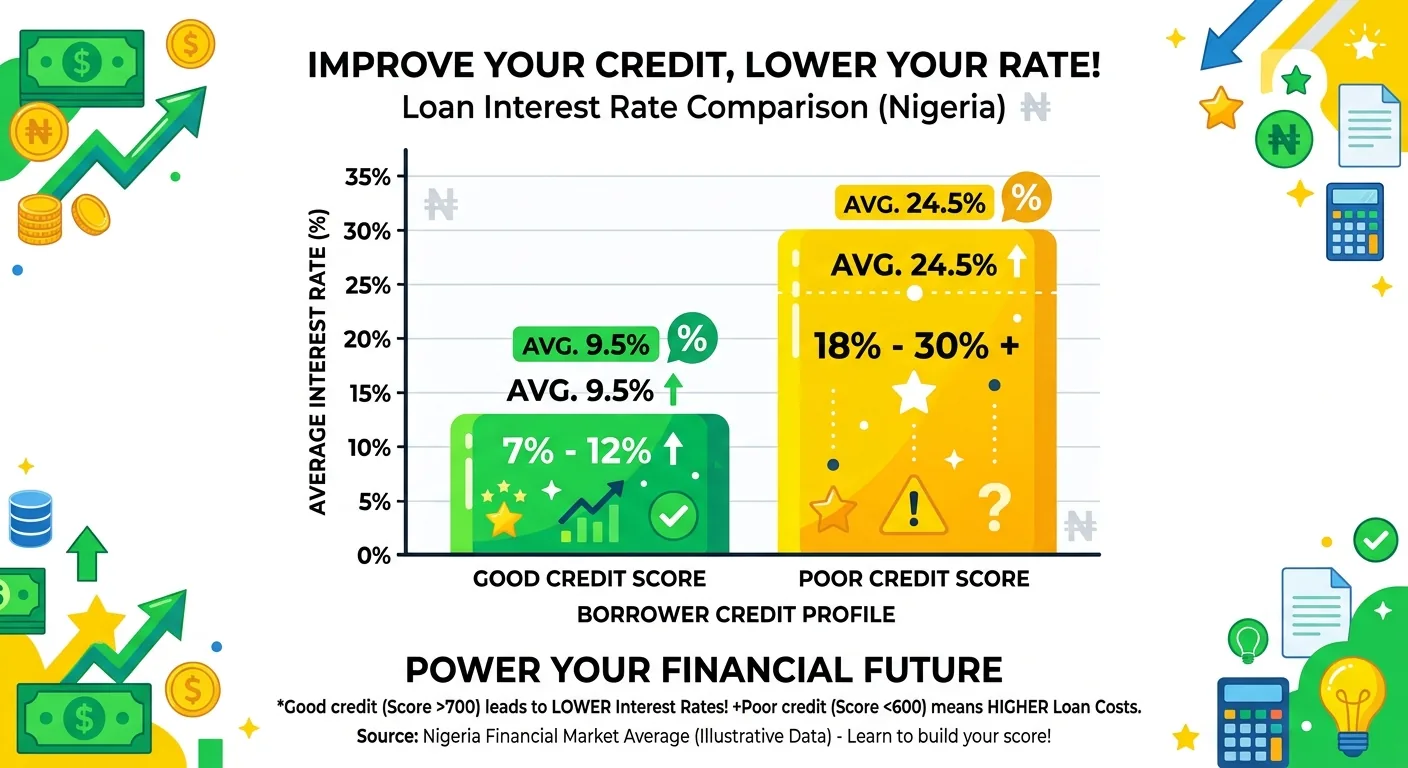
A borrower with a good credit score Nigeria lenders trust can access ₦500,000 at 3–5% monthly interest over 12 months.
A borrower with a poor credit score who does manage to get approved — usually through high-risk lenders — may face 15–25% monthly interest, shorter repayment windows, and aggressive collateral demands.
On a ₦200,000 loan, the difference between 4% and 15% monthly interest translates to tens of thousands of extra naira over six months. That is real money lost — caused directly by a damaged score.
Beyond interest rates, a low credit score Nigeria bureaus report can:
- Get your bank loan application rejected outright
- Reduce your borrowing limit on apps you already use
- Block you from salary advance products at your company
- In some cases, affect background checks for certain employment opportunities
How to Check Your Own Credit Report in Nigeria
You are legally entitled to one free credit report per year from each bureau. Here is exactly how to access yours.
CRC Credit Bureau — Visit www.creditcentralng.com. Submit your BVN and a valid ID. Reports are typically delivered by email within 24–48 hours.
FirstCentral Credit Bureau — Visit www.firstcentralcreditbureau.com. Their portal allows online self-service. Submit BVN and ID, then track your report status online.
CreditRegistry — Visit www.creditregistry.ng. Same BVN and ID verification process. Many users report faster turnaround through their online portal.
When your report arrives, look for:
- Loans you do not recognise — identity fraud is more common than banks will admit
- Every fully repaid loan should be marked "Closed" or "Settled," not still showing as active
- Too many recent credit enquiries — this is a red flag even to algorithms
If you find errors, you have the legal right to dispute them. Send a formal dispute letter to the bureau and copy the lender that reported the incorrect data. Under the Credit Reporting Act, they are required to investigate and respond within a specified window.
7 Practical Ways to Improve Your Credit Score Nigeria Bureaus Track
1. Pay every existing loan on time — even the small ones.
A ₦10,000 loan paid clean is worth more to your score than a ₦500,000 loan half-paid. Set calendar reminders. Automate repayments where your bank allows it.
2. Settle defaults formally — not just by transfer.
If you paid a defaulted loan, make sure the lender updates the bureau record. Many Nigerians pay a settled debt but the bureau still shows it as defaulted. Get written confirmation of settlement.
3. Do not close old loan accounts immediately after repaying.
An old account with a clean repayment record is an asset. Let it sit as "closed in good standing" on your report rather than wiping the trail.
4. Avoid applying for multiple loans at the same time.
Research your best option first, then apply — not the other way around. Every hard inquiry leaves a mark.
5. Keep your active loan balances below 70% of your available limit.
If an app has given you a ₦100,000 limit and you are always borrowing ₦99,000, scoring models read that as financial stress.
6. Use a mix of credit types responsibly.
If your only credit history is from one loan app, consider whether a small bank personal loan or cooperative loan adds breadth to your profile.
7. Build thin-file credit intentionally.
If you have never borrowed before, take a small loan you can easily repay ahead of schedule. You are building a credit passport for the bigger loans ahead.
Common Mistakes That Quietly Destroy Your Credit Score Nigeria Lenders See
Ignoring small loan app debts because "it is just ₦5,000."
A ₦5,000 default on PalmCredit is recorded the same way as a ₦500,000 bank default. It shows as a failure to repay — full stop.
Assuming the loan is finished when the calls stop.
When a lender stops chasing you, most Nigerians assume the debt is gone. It is not. The record stays on your bureau file for up to seven years in some cases, even after the lender writes it off internally.
Borrowing with someone else's BVN or identity.
This destroys that person's credit score and exposes both parties to legal consequences under the Credit Reporting Act.
Never checking your own report.
Errors happen. Fraud occurs. If you are not reviewing your report at least once a year, you will not catch these problems until they block a loan you genuinely need.
What NYSC Members and First-Time Workers Should Know About Credit Score Nigeria Bureaus Track Early
If you are under 30, in NYSC, or just starting your first job, your credit file is probably empty right now. That is called being credit invisible — and it creates its own problems. Many lenders reject a borrower with no credit history almost as quickly as they reject someone with bad credit, because there is nothing to evaluate.
The fix is deliberate and simple: build a thin credit file on purpose. Take a small loan — ₦5,000 to ₦20,000 — from a reputable app. Repay it three days before the due date. Repeat this three to four times over a year. You now have a clean, positive credit footprint that opens bigger doors later.
Do not wait until you desperately need ₦500,000 to discover your credit score Nigeria bureaus hold on file is either zero or negative. Build it now, when the stakes are low and amounts are manageable.
Fix Your Credit Score Nigeria Lenders Check Before You Ever Need That Loan
Credit scores do not punish poor people. They punish financial invisibility and bad repayment habits — and both of those are things you can change.
The salary earner who repays ₦30,000 loans consistently over 24 months will access a ₦500,000 bank loan at competitive rates. The person who earns twice as much but defaults and applies to twelve lenders in a panic will find every door closing at once.
Your credit score Nigeria lenders check is not about your income. It is about your behaviour. And unlike your salary, your behaviour is entirely within your control.
Check your report. Know your score. Fix what is broken. Build what does not yet exist. Because lenders are not looking at your account balance before they say yes or no — they are looking at your history. Make sure that history tells the story you want told.
