

The Moment "Just Sign Here" Quietly Rewires Your Financial Future
Your colleague looks you in the eye: "Bros, e is just your name and signature. The cooperative just needs a guarantor. I will handle everything, I promise you."
You sign.
Five months later, the cooperative is calling your direct line. Your salary slip shows an unexpected deduction. Your name is sitting in a credit bureau report you did not put it in. And your colleague? New city. New number. Gone.
This is not fiction. This is what guarantor loans Nigeria borrowers and their unlucky guarantors live through every single year — in cooperatives, microfinance banks, and salary-advance schemes across Lagos, Abuja, Port Harcourt, and every civil service corridor in between.
Before your pen touches any paper as a guarantor — or before you ask someone else to sign for you — read this guide completely. Because your signature is not a favour. It is a legally binding contract.
What Is a Guarantor Loan in Nigeria?
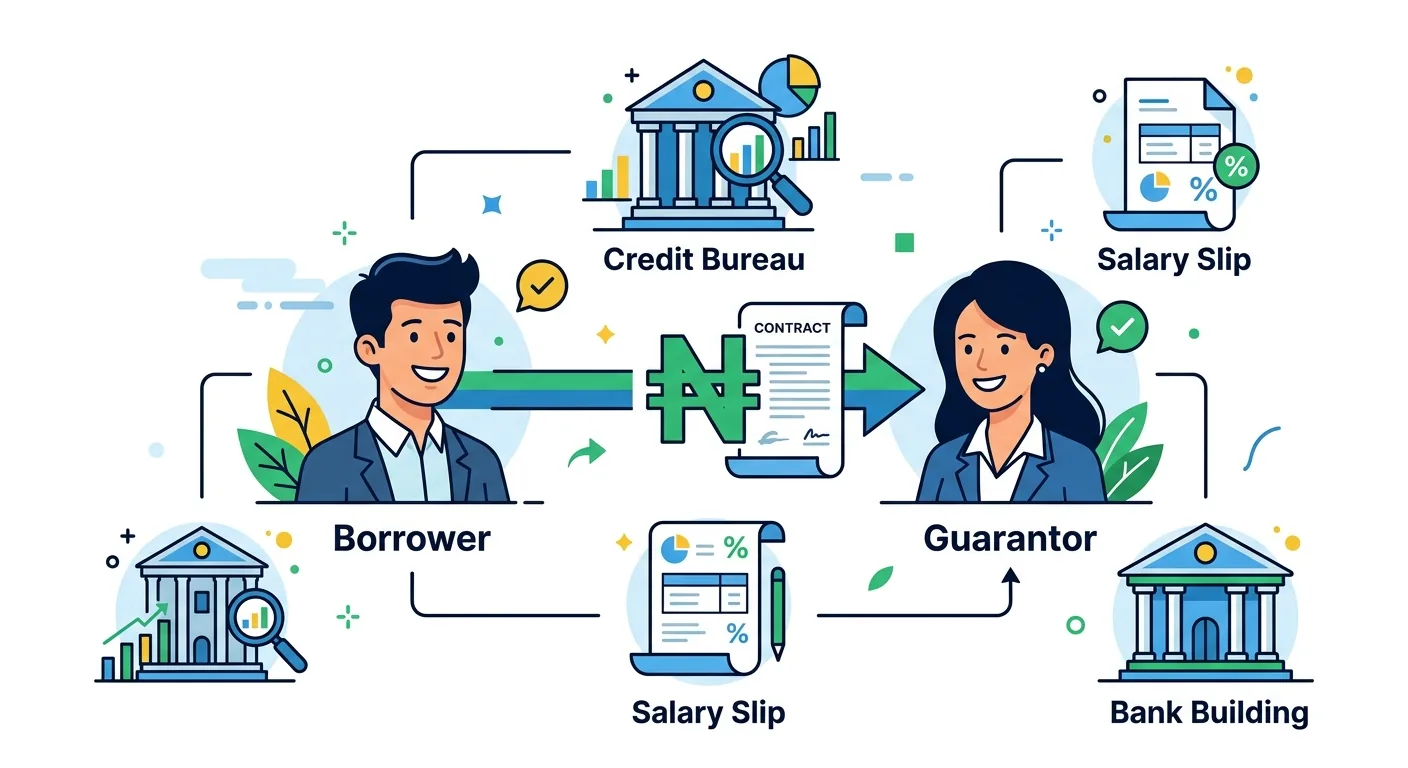
A guarantor loan is a loan where the lender requires a second person — the guarantor — to promise that if the borrower fails to repay, the guarantor will cover the debt.
The lender is essentially saying: "I do not fully trust you alone to pay this back. Bring someone whose word and wallet I can also hold accountable."
Guarantor loans Nigeria borrowers encounter most often come from:
- Civil service cooperative societies — by far the most common source
- Microfinance banks (MFBs) — typically for amounts above ₦100,000
- Commercial banks — for larger personal loans or thin-credit customers
- Employer-backed salary advance schemes — where colleagues sign for each other
- Emerging fintech platforms — increasingly adding guarantor features for salaried workers
Loan amounts range from ₦50,000 to several millions depending on institution and the borrower's salary grade.
The Legal Reality Nobody Explains at the Signing Table
When you sign as a guarantor, you are making a legal promise to the lender. Most Nigerians never realise this because the process is rushed, informal, and positioned as a formality.
It is not a formality. Here is what that document actually commits you to:
You become jointly liable for the full debt. If the borrower defaults — misses payments, disappears, or refuses to pay — the lender has full legal right to pursue YOU for the outstanding balance.
The lender can skip the borrower and come directly to you. Depending on how the guarantee clause is written, you may be the first person contacted at default, not the last resort.
Your credit record takes the hit. With CRC Credit Bureau and First Central Credit Bureau actively reporting to Nigeria's Credit Risk Management System (CRMS), your name attached to a defaulting loan damages YOUR credit profile — even though you never spent the money.
Your employer can be contacted. In civil service and cooperative settings, lenders write directly to your department, trigger automatic salary deductions, or generate HR queries that your colleagues will eventually hear about.
Your assets can be legally pursued. In formal bank and MFB recovery processes, court orders against your accounts or property are real possibilities — not scare tactics.
This is the reality that the borrower's charming smile and "e no go reach that level" never tells you.
Who Requests Guarantors in Nigeria? Know the Landscape
Understanding which institutions use guarantors — and how seriously they enforce guarantor obligations — is essential before navigating guarantor loans Nigeria-wide.
Cooperative Societies are the most common source. Civil servants in staff cooperatives face guarantor requirements frequently. When salary deductions fail, cooperatives pursue guarantors aggressively — including writing directly to the guarantor's department head.
Microfinance Banks like LAPO MFB and AB Microfinance Bank have documented recovery processes specifically targeting guarantors when loans default. They take this seriously.
Commercial Banks require guarantors for larger personal loans or customers with limited credit history. At tier-1 banks, guarantee documents are dense legal contracts — not the informal one-page forms cooperatives use.
Fintech Platforms are now adding guarantor features as they move beyond pure algorithm-based lending. This is growing quickly among platforms targeting salaried Nigerians.
What Actually Happens to You When the Borrower Defaults
No softening. Here is the real cost when guarantor loans Nigeria situations go wrong:
Your money gets taken. In cooperative settings, direct salary deductions begin immediately. In formal lender settings, account freezes and legal recovery follow.
Your credit score gets damaged. A red flag on your credit profile can disqualify you from accessing YOUR OWN loan when you genuinely need emergency funding.
Your job becomes complicated. In civil service environments, guarantor disputes produce official queries, interdepartmental memos, and deductions that colleagues will eventually notice.
The relationship gets destroyed. The friendship or family bond that existed before the signing rarely survives a default — and yet you still legally owe the money.
Your peace of mind disappears daily. Even before any default, knowing that someone else's financial discipline controls your financial safety creates real, sustained psychological pressure.
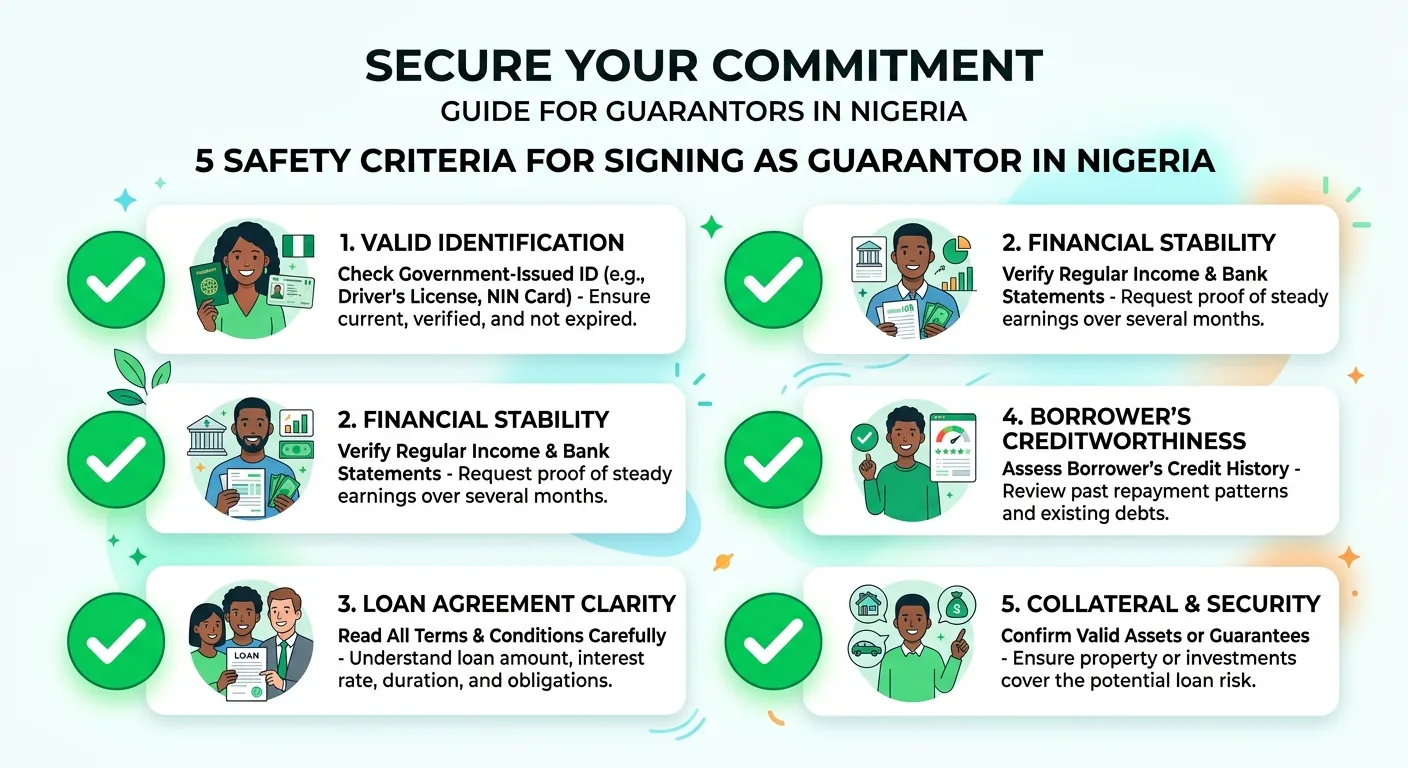
6 Sharp Questions to Ask BEFORE You Sign as Guarantor
Do not let your pen move until you have honest, specific answers to all six:
1. What is the exact naira amount I am guaranteeing?
Get this in writing. "Small loan" is not an answer.
2. What are the full repayment terms — amount, duration, interest rate?
You need to judge whether this borrower can realistically sustain the repayment schedule.
3. Under what exact conditions will the lender contact me directly?
Ask the lender — not the borrower — whether you are pursued immediately on first default or only after other recovery attempts.
4. What is my maximum total liability?
Some agreements cap guarantor liability at the original principal. Others include accrued interest and late penalties. That difference can be hundreds of thousands of naira.
5. Can I withdraw as guarantor before the loan is repaid?
Most lenders will say no. Understand your exit options — or confirm there are none — before signing.
6. What is the borrower's current total debt load?
How many loans are already running? What is their monthly repayment burden today? If they cannot answer this honestly, that evasion is your answer.
When Is It Actually Safe to Be a Guarantor?
There are scenarios where guaranteeing a loan is a reasonable decision:
- You know the person's financial habits intimately — a spouse, sibling you have lived with, or a colleague with a verified clean repayment history
- Repayment is salary-deducted automatically, not dependent on the borrower's personal willpower each month
- The lender is a licensed, regulated institution — not an informal moneylender or unverified platform
- You have a private written agreement with the borrower covering what happens if repayment fails
- You could financially absorb the worst-case scenario without destroying your own financial stability
If two or more of these conditions are absent, step back. Guarantor loans Nigeria-wide have destroyed more relationships than unpaid personal debts — precisely because people skipped this analysis before signing.
How to Use a Guarantor to Access a Loan — If You Are the Borrower
If you need a guarantor to unlock a loan, the person agreeing to sign is making a genuine financial sacrifice. Treat it accordingly:
Be completely transparent from the start. Share the exact loan amount, interest rate, repayment timeline, and your existing debt situation. No surprises, ever.
Create a private written agreement. Beyond the lender's documents, write your own document with your guarantor that specifies how you will handle difficulty — including how you will notify them before the lender does.
Never go silent if you are struggling. Contact your guarantor first if repayment becomes difficult. Give them a chance to help you find a solution before the lender's formal recovery begins.
Formally release your guarantor when the loan is repaid. Get written confirmation from the lender that the guarantee obligation is discharged — and give your guarantor a copy immediately.
Your Legal Rights as a Guarantor in Nigeria
Most people navigating guarantor loans Nigeria situations do not realise they have enforceable rights:
Right to prompt default notification. A responsible lender must inform you when repayment fails — not months later when penalties have multiplied the balance.
Right to full loan statements. You can request the current outstanding balance, complete repayment history, and loan status at any point during the guarantee period.
Right to recover from the borrower if you are forced to pay. Nigerian law allows you to sue the original borrower for whatever amount you were compelled to cover. This legal principle — subrogation — exists and is enforceable even if it requires court action.
Right to report illegal lender harassment. If a lender uses public shaming, threats, or social media exposure against you as guarantor, report them to the FCCPC (Federal Competition and Consumer Protection Commission) or the CBN Consumer Protection Department. These tactics are illegal.
How to Protect Yourself If You Have Already Signed
Already signed? Here is your practical action plan:
- Obtain a complete copy of the guarantee agreement. Read every clause. Know your exact maximum liability.
- Stay in active contact with the borrower. Monitor their repayment status — do not wait for the lender to deliver bad news.
- If the borrower begins struggling, get involved early. Help them restructure or seek alternative repayment support before formal default is recorded.
- If the lender contacts you, respond professionally and document every communication in writing.
- Consult a lawyer if recovery tactics seem unlawful. Many Nigerian university law clinics offer free or affordable consultations.
Sharp-Sharp Lesson: Your Signature Is a Contract, Not a Favour
The most expensive phrase in Nigerian financial life is: "E no go reach that level."
It always reaches that level.
Guarantor loans Nigeria lenders enforce as full legal contracts — and Nigerian courts treat them exactly that way. Your signature creates obligations that can affect your salary, your credit record, your bank account, and your daily peace of mind for years.
This does not mean you should never help people. It means help with your eyes fully open, your questions genuinely answered, and your risks honestly understood.
Before you sign for anyone — know exactly what you are signing.
Before you ask anyone to sign for you — be worthy of the financial trust they are placing in you.
Your name and your financial reputation are not worth one rushed signature on a document you never fully read.
Be sharp. Stay informed. Protect your name.
Frequently Asked Questions
Q: Can a lender come after me as guarantor without first pursuing the borrower in Nigeria?
A: Yes. Depending on how the guarantee clause in your agreement is written, many Nigerian lenders — especially cooperative societies and MFBs — can contact and pursue you as guarantor immediately upon default without exhausting all recovery options against the borrower first. Always ask this question directly before you sign.
Q: Does being a loan guarantor in Nigeria affect my own credit score?
A: It can. If the loan you guaranteed defaults and your name is attached to the account in the lender's records, this can appear on your credit profile at Nigerian credit bureaus like CRC Credit Bureau or First Central Credit Bureau — potentially affecting your ability to access your own loans in the future.
Q: Can I legally get my money back if I was forced to repay a loan I guaranteed in Nigeria?
A: Yes. Nigerian law recognises your right of subrogation — meaning if you are compelled to repay the borrower's debt as guarantor, you have the legal right to pursue the original borrower to recover that amount. This may require filing a civil claim in court, but the right is real and enforceable.
