

Most Nigerians do not plan to default. It creeps up — a delayed salary, an unexpected expense, a due date that arrived three days too early. You told yourself you would sort it next week. You silenced the app notifications. You moved on.
What you did not see was the machinery that started turning the moment that payment missed its window.
Loan default in Nigeria is not simply a financial event. It is a chain reaction that touches your BVN, your credit bureau record, your emergency contacts, and in some cases, your employer. This article walks you through every stage — clearly, without sugarcoating — so you know exactly what is coming and what you can still do about it.
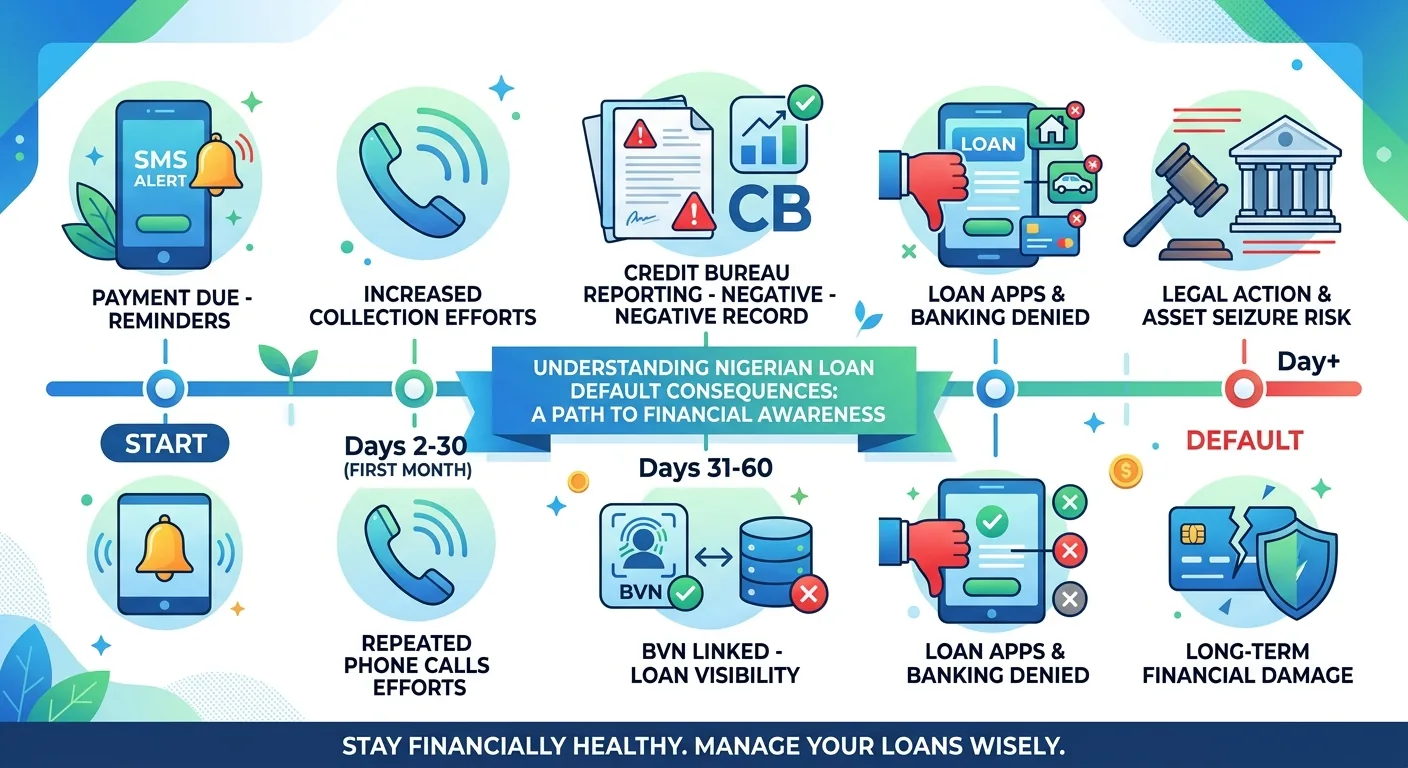
What Loan Default Actually Means in Nigeria
Loan default begins the moment you miss a single scheduled payment without prior arrangement with your lender. Not when you disappear completely. Not when the lender gives up calling. Day 1.
Nigerian lenders classify default across three stages:
- Soft default: 1–29 days overdue. Still recoverable, but penalties are already running.
- Hard default: 30+ days overdue. Your name formally enters credit bureau records as a non-performing borrower.
- Write-off: 90–180 days overdue. The lender marks the loan as a loss, sells your debt to a collection agency, or pursues legal action.
The lender's internal clock starts on Day 1 — not on the day they finally reach you.
Stage 1 — The First 7 Days After Missing Payment
Automated SMS alerts and push notifications arrive multiple times daily. The language opens politely — "Dear customer, your repayment of ₦15,500 was due today." By Day 3, the tone shifts noticeably.
Penalty interest begins accumulating immediately. Apps like FairMoney, Carbon, Branch, and Palmcredit charge daily penalty fees from the moment you cross your due date — typically 1%–2% per day on the outstanding balance. On a ₦30,000 loan, that is ₦300–₦600 per day stacking silently on top of what you already owe.
Your loan is internally flagged as delinquent. You have been moved into a high-risk bucket inside the lender's system. This affects your future borrowing limits on that platform even if you eventually repay in full.
At this stage, one honest message to the lender explaining your situation can reduce the escalation. Most borrowers skip this step because of shame. That shame compounds just like the penalties do.
Stage 2 — Days 8 to 30: When Things Get Real
This is where the pressure becomes visible beyond your own screen.
Phone calls start — and not just to you. Many FCCPC-registered loan apps will begin contacting numbers you listed as emergency contacts during your application. This is legal only if you consented during registration — and buried in those terms and conditions you clicked past, you almost certainly did.
Penalty fees compound fast. That ₦30,000 loan? By Day 30 at 1% daily penalty, you are looking at ₦9,000 in penalty charges alone — before you have repaid a single kobo of principal. Some borrowers discover they now owe nearly double the original amount.
Your credit bureau file starts receiving updates. Nigeria operates three active credit bureaus: CRC Credit Bureau, FirstCentral Credit Bureau, and CreditRegistry. Licensed lenders are required to report loan performance data monthly. By Day 30, your missed payment will likely have been formally submitted.
This is the stage where loan default Nigeria consequences shift from inconvenient to consequential.
Stage 3 — 30 Days and Beyond: Your BVN Enters the Blacklist
When a licensed lender reports your loan default in Nigeria to a credit bureau, your BVN becomes linked to that negative record. Your BVN is your financial identity — it connects every bank account, every mobile money wallet, every future loan application you will ever make in Nigeria.
Here is what a credit bureau blacklisting means in practical terms:
- New loan applications get rejected across platforms that previously approved you instantly.
- Your borrowing limits fall to zero on all platforms that query bureau data before approval.
- The CBN's Credit Risk Management System (CRMS) can flag your BVN as high-risk, affecting formal banking relationships.
- A bad credit bureau record in Nigeria follows you for 3–5 years even after the debt is fully repaid.
The record shows a default history even with a "settled" status beside it. Settled does not mean erased.
What Credit Bureaus in Nigeria Actually Do With Your Data
Credit bureaus collect repayment data from banks, microfinance institutions, BNPL platforms, and digital loan apps. They compile this into a credit report tied to your BVN and NIN.
When you apply for any credit product, lenders pull this report. What they see includes:
- Every loan you have ever taken
- Whether you paid on time, late, or not at all
- Current outstanding balances
- Any defaults or write-offs in your history
A loan default Nigeria entry tells every future lender: this person did not repay as agreed. Even after full repayment, the history remains visible. The good news is that consistent clean repayment behaviour over 12–24 months will gradually improve your standing — but you have to actively rebuild it.
Can Loan Apps Really Contact Your Boss or Family?
Yes — but the line between legal and illegal here is precise.
Legally, licensed FCCPC-registered loan apps can only contact people you explicitly listed as guarantors or emergency contacts. They cannot harvest and blast your entire phone contacts list.
In practice, some unregistered or aggressive lenders have been documented sending shame-texts to contacts gathered through phone permissions you granted during app installation. This is illegal under CBN digital lending guidelines and has resulted in several apps losing their operating licences.
If an app contacts your employer or family without authorisation:
- Screenshot every message immediately as evidence.
- File a formal complaint with the FCCPC via their official complaint portal.
- Report to the CBN Consumer Protection Department.
These complaints carry weight. Apps have been delisted for exactly this behaviour.
Civil Servants and NYSC Members Face Extra Risk
Civil servants carry a specific vulnerability that regular app borrowers often overlook: salary deduction orders.
Some microfinance banks and cooperative loan schemes have direct agreements with the IPPIS (Integrated Payroll and Personnel Information System) or state government payroll offices. If you default, they can legally instruct your employer's accounts department to deduct the outstanding balance directly from your net pay — sometimes without advance warning to you.
For NYSC members, the damage is both reputational and timed catastrophically. Defaulting during your service year means your BVN enters formal employment already flagged. That loan default Nigeria record will surface in lender checks before your first salary even clears.
The casual advice to "just ignore the loan app" is genuinely dangerous for people in these two categories.
Can a Loan App Actually Sue You?
Short answer: yes, but rarely for small amounts.
Pursuing a debtor through Nigerian courts is expensive and slow. For loans below ₦100,000, most digital lenders will not litigate — they will sell your debt to a collection agency or blacklist your BVN and absorb the loss.
For loans above ₦500,000 with formal institutions — microfinance banks, consumer finance companies, cooperative societies — legal action is a real possibility. Employers have received official demand letters. Guarantors have been drawn into disputes. This is not theoretical.
The practical line every borrower should carry: under ₦100,000 with a digital app — blacklist risk. Above ₦500,000 with a formal institution — legal risk.
How to Recover From Loan Default Nigeria — The Exact Steps
If you are already in default, here is your recovery sequence.
Step 1: Stop hiding. Contact the lender directly. Call their customer service or send a formal written message. State your situation honestly. Ask for restructuring or a settlement offer. Licensed lenders prefer recovering something over recovering nothing.
Step 2: Negotiate on penalty fees specifically. The principal and agreed interest are rarely waivable. Accumulated penalty charges almost always are. Frame the conversation like this:
"I acknowledge I owe ₦25,000 in principal and interest. I cannot pay the additional ₦18,000 in penalties due to financial hardship. I will pay the ₦25,000 today in exchange for a written waiver of penalty fees and an immediate credit bureau update to settled."
Many lenders accept this because managing delinquent loan accounts is operationally expensive. Ask formally. Get their response in writing.
Step 3: Pay and collect written confirmation. Never pay a defaulted loan without receiving official written confirmation — email or stamped receipt — that the debt is fully settled. This is your evidence for all future bureau disputes.
Step 4: Request a credit bureau update in writing. After payment, formally request that the lender update your bureau record to "settled." CBN guidelines obligate them to do this — but they do not always act automatically. Follow up in writing.
Step 5: Rebuild with clean repayment behaviour. Take a small loan from a licensed lender and repay it on schedule. Repeat two or three times. Consistent clean repayment over 12–24 months will gradually restore your credit standing.
Your Financial Name Is Worth More Than Any Emergency Loan
The real cost of loan default Nigeria is rarely just the missed payment amount. It is the loan rejected six months later when you face a genuine emergency. It is the employer background check that surfaces a credit bureau flag. It is the financial reputation built across years of careful behaviour that can unravel inside thirty days.
Cash pressure is real. Sometimes you genuinely cannot pay on time — that is a human situation, not a character failure. But silence makes every stage of default worse. Engaging the lender honestly, even when it is uncomfortable, almost always produces a better outcome than disappearing.
Your BVN is your financial identity in Nigeria. It travels with you into every bank, every platform, every future transaction.
Guard it accordingly. Because unlike a bounced alert, a loan default Nigeria record does not disappear by morning.
Frequently Asked Questions
Q: How long does a loan default stay on my credit bureau record in Nigeria?
A: A loan default in Nigeria typically remains on your credit bureau record for 3–5 years from the date it was reported, even after you repay the full amount. The status will update to "settled" once you pay, but the history of default remains visible to lenders during that period.
Q: Can I be arrested for not paying a loan app in Nigeria?
A: No. Failing to repay a loan is a civil matter in Nigeria, not a criminal one. You cannot be arrested for loan default. However, licensed lenders can pursue civil court action for significant amounts, report your BVN to credit bureaus, and engage debt collection agencies. Unlicensed apps that threaten criminal arrest are acting illegally and should be reported to the FCCPC.
Q: What is the fastest way to clear a loan default from my BVN in Nigeria?
A: The fastest path is to contact the lender directly, negotiate a settlement — particularly requesting a waiver of accumulated penalty fees — pay the agreed amount, collect written confirmation, and formally request a credit bureau update to "settled" in writing. After settlement, consistent clean repayment behaviour over 12–24 months is the most effective way to rebuild your credit standing.
